But the heart of the mission is the buildings themselves. On the website, for instance, users can uncover the opulent High Modernism of the apartment and display case Paul Rudolph built for himself on Beekman Place—and then discover that its gay roots go much further back, as the home of First Lady of the Theater Katharine Cornell and her director-producer husband Guthrie McClintic. (Both were gay and united in an early example of so-called lavender marriages.) Such through lines challenge our understanding of both desire and design, serving as timelines for liberation. “The work they’re doing to show the cultural importance of these spaces,” Ryan says, “provides an architecture in and of itself for how we remember queer history. These places matter.”
Year: 2022
Julius’ Bar designated as NYC landmark in unanimous vote
December 6, 2022
By: Matt Tracy
from Gay City News
The New York City Landmarks Preservation Commission has unanimously designated Julius’ Bar — the oldest gay bar in the city and site of the 1966 “sip-in” demonstration — as an official landmark.
The 11-0 vote, held during a virtual hearing on December 6, was largely symbolic because the bar was already previously protected by a broader landmark designation in the Greenwich Village Historic District, which is made up of a collection of more than 2,000 buildings across 100 blocks in Manhattan. Still, it was hailed as a triumph following a decade-long push to protect the building. Groups such as Village Preservation and the NYC LGBTQ Historic Sites Project were instrumental in the campaign to designate the bar, which is located at 159 West 10th Street.
The Landmarks Preservation Commission praised the work of the LGBT Historic Sites Project, which has documented numerous locations across the five boroughs that have carved out a place in LGBTQ history.
“The NYC LGBTQ Historic Sites Project is thrilled that the Landmarks Preservation Commission has designated the Julius’ Bar Building as an official landmark,” Andrew Dolkart, co-director of the NYC LGBTQ Historic Sites Project, said in a written statement. “One of the first initiatives that the Sites Project undertook after its founding was the completion of the nomination that succeeded in getting Julius’ listed on the National Register of Historic Places for its significance as the site of the so-called “sip-in,” at which three courageous gay men sought to challenge the New York State rule that a bar could not serve a known homosexual.”
Walkers in the City
November 27, 2022
By: Robert Sullivan
from The New York Times
At the outset of the Covid-19 lockdown, Michael Kimmelman, the New York Times architecture critic, invited various architects, urban planners, writers and other experts to suggest walking tours of New York City, hoping that the itineraries would offer “examples of how the city remains beautiful, inspiring, uplifting.” Within days, the first account of what would ultimately be 17 walks was published, a conversation between a critic and a thinker, set within a particular area of the city. Now those walks, plus three more, have been assembled into a collection, “The Intimate City,” each chapter a geographic memoir: streetscape-jogged annotations on history, infrastructure, planning and combinations thereof, complemented by photos, many from the original series. “I was on the lookout,” Kimmelman says in his introduction, “for stories, both intimate and about the city, that I thought seasoned, savvy New Yorkers might find surprising — tidbits of history, law, technology or gossip I hadn’t heard myself, or that revealed something about the people who were telling the stories.”
… Kimmelman’s own recollections of growing up in Greenwich Village dovetail with the historical insights of Andrew Dolkart, an architectural historian and the co-founder of the NYC LGBTQ Historic Sites Project, which aims to increase public awareness of local sites important to L.G.B.T.Q. history. When activists applied to have the Stonewall Inn listed on the National Register, Dolkart reports, they sought the designation for adjoining streets — which also figured in the 1969 uprising for L.G.B.T.Q. rights — at the same time, and were advised to follow guidelines for registering Civil War battlefields.
Brooklyn Gets First LGBTQ+ Landmark With Designation of Lesbian Herstory Archives
November 22, 2022
By: Anna Bradley-Smith
from Brownstoner
Commissioners on the city’s Landmark Preservation Commission unanimously voted to landmark the Park Slope headquarters of the Lesbian Herstory Archives in a public meeting today.
The vote followed an October 25 public hearing where six people testified in support of landmarking the building at 484 14th Street due to its cultural significance. “Most lesbians don’t inherit queer culture from our parents, the Lesbian Herstory archives is our birthright and it’s the place where we can go to learn our own history,” LHA coordinating committee member Colette Denali Montoya-Sloan told commissioners at the hearing.
In a press release, project manager of the NYC LGBTQ Historic Sites Project Amanda Davis said the group was thrilled the women-owned building was now officially recognized as a New York City landmark, “further solidifying the importance of including LGBTQ history in the broader narrative of American history.”
“The designation — the first for an LGBTQ site in Brooklyn — acknowledges the pioneering lesbian women who, nearly 50 years ago, came together to create an affirming space for their community. Perhaps most significantly, these women reclaimed their past by saving and preserving lesbian-related records, photographs and ephemera for future generations of queer women,” Davis said.
Read the original story at Brownstoner.
Featured thumbnail by Susan De Vries.
WATCH: NYC LGBTQ Historic Sites Project Receives Prestigious Trustees’ Award from the National Trust for Historic Preservation
November 5, 2022
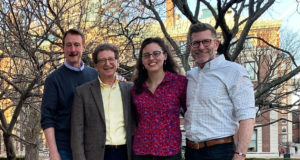 The NYC LGBTQ Historic Sites Project is thrilled and honored to share that our work to identify and document NYC’s place-based LGBT history was honored by the National Trust for Historic Preservation Friday, November 4th, with their Trustees’ Award for Organizational Excellence, one of our field’s highest honors. The award was given at the PastForward Conference, in a ceremony hosted by old house icon Bob Vila.
“Each year at the PastForward Conference we come together to recognize those making a real difference in historic preservation. This year’s recipients embody not just the preservation of American history, but also demonstrate how preserving historic places can play a key role in addressing critical issues of today, including climate change, equality, and housing.” — Paul Edmondson, president and CEO of the National Trust for Historic Preservation
Since its founding in 2015, the Project has now identified, researched and mapped over 400 sites across New York City’s five boroughs which connect the public viscerally to the places — residences, bars and venues, public spaces, and more — where LGBT people have contributed to American culture.
About the Trust’s selection of the Project for the 2022 Trustees’ Award for Organizational Excellence: The NYC LGBTQ Historic Sites Project is a nationally-recognized and influential cultural heritage initiative and educational resource that identifies and documents diverse extant LGBT sites from the 17th century to 2000. The only permanent organization of its kind in the US, the project staff have created an interactive website, National Register nominations, publications and public programs, and school educational materials, among other resources. Sitting at the intersection of historic preservation and social justice, the organization has been particularly eager to document LGBT sites associated with women and Black, Asian, Latinx, trans, and gender-variant communities. In the near future, they hope to prioritize local sites of LGBT history associated with Indigenous and Two Spirit Peoples.
Landmarks Holds Public Hearing for Julius’ Bar
November 21, 2022
By: Cassidy Strong
from CityLand
Located at the corner of West 10th Street and Waverly Place, Julius’ holds great significance in NYC’s LGBTQ+ history and is undergoing Individual Landmark consideration. On November 15, 2022, the Landmarks Preservation Commission held a public hearing to discuss landmarking Julius’ Bar, located at 159 West 10th Street in Manhattan. The building was previously calendared for Individual Landmark consideration on September 13.
The public hearing began with a presentation from Kate Lemos McHale, Landmarks’ Director of Research. McHale described Julius’ Bar as “New York City’s most significant site of pre-Stonewall LGBTQ activism.” In 1966, three years before the Stonewall Rebellion, four activists with the Mattachine Society held a “Sip-In” at Julius’ Bar to protest the closure of restaurants and bars serving queer people. Modeling this direct action after the Civil Rights Movement, the Sip-In showcased the frustration and bold ideas of NYC’s gay community years before the Gay Liberation Movement.
Andrew Dolkart, a historic preservation professor, spoke next on behalf of the NYC LGBTQ Historic Sites Project. Dolkart shared that the Project “strongly supports” landmarking Julius’ Bar, which is often the last stop on their walking tours of queer historic sites, and that their research led to Julius’ being listed on the National Register of Historic Places in 2016.
Read the full story from CityLand.
Featured thumbnail via CityLand
Greenwich Village, Storied Home of Bohemia and Gay History
November 21, 2022
By: Michael Kimmelman
from The New York Times
The architectural historian Andrew Dolkart leads a walk past landmarks like the Stonewall Inn, Julius’ bar and the home of Lorraine Hansberry; excerpted from Kimmelman’s new book, “The Intimate City: Walking New York.”
Testimony in Support of the Proposed Designation of the Julius’ Bar Building as a New York City Landmark
November 11, 2022
To be presented by Project co-director, Andrew Dolkart, at the NYC Landmarks Preservation Committee public hearing on Tuesday, November 15, 2021.
My name is Andrew Dolkart, and I am one of the co-directors of the NYC LGBTQ Historic Sites Project, a cultural heritage initiative founded by historic preservationists in 2015 to document historic places connected to the lesbian, gay, bisexual, and transgender community in the city’s five boroughs.
The Project strongly supports the designation of the Julius’ Bar Building as a New York City Landmark. In the early 1990s, my co-directors, Jay Shockley and Ken Lustbader, and I were part of the Organization of Lesbian and Gay Architects + Designers (OLGAD), a pioneering group that advocated for LGBT historic sites at a time when the field of historic preservation paid little attention to sites of cultural significance, let alone ones connected to the LGBT community. In 1994, OLGAD created what we believe is the first map in the country to document LGBT historic places, and the building that houses Julius’ was included in this effort.
In 2015, when the NYC LGBTQ Historic Sites Project formed, one of our first priorities was to continue what OLGAD began more than twenty years earlier. We took the initiative to undertake the necessary research and write the text for the nomination of Julius’ to the National Register of Historic Places, which was approved in April 2016, one day before the 50th anniversary of the so-called “Sip In”.
Julius’ is located just a few minutes’ walk from the more famous Stonewall Inn, but its place in LGBT history is just as significant. The events at Stonewall in June 1969 did not exist in a vacuum. In the decades leading up to that uprising, bars were one of the few places that LGBT people could gather openly. Yet, at the same time, there were always inherent risks since the mere presence of a homosexual in a bar was considered to be disorderly: frequent police raids and other forms of entrapment could lead to arrest, loss of employment, and physical and mental abuse, among other threats. With photographers in tow, the game-changing public action by the Mattachine Society on April 21, 1966, which culminated at Julius’, was the earliest planned effort to capture LGBT discrimination in real time.
When we give walking tours in the area, we typically end at Julius’, and young people, in particular, are often surprised to learn that at one time, even in New York City, even in Greenwich Village, LGBT people faced these hardships in bars, of all places. Julius’ is therefore not only a great place to gather and have drinks with friends, but also a valuable teaching tool.
We thank Helen Buford, the owner of Julius’, for her incredible stewardship of the bar and its history, and for collaborating with and supporting our Project from the very beginning. The NYC LGBTQ Historic Sites Project proudly supports this proposed designation.
Thank you.
Landmarks Holds Public Hearing for Lesbian Herstory Archives
November 9, 2022
By: Cassidy Strong
from City Land
On October 25, 2022, the Landmarks Preservation Commission held a public hearing to discuss landmarking the Lesbian Herstory Archives in Park Slope, Brooklyn. Located at 484 14th Street within the Park Slope Historic District, the building was previously calendared for Individual Landmark consideration on June 28.
[Amanda Davis, Project Manager of the NYC LGBTQ Historic Sites Project] stated that the project “strongly supports the designation of the Lesbian Herstory Archives as a New York City Landmark,” pointing out that it would be the first LGBT site to be landmarked in Brooklyn. Davis also shared that when the project first launched its website with an initial 100 sites, the Lesbian Herstory Archives was included, and that the Archives’ resources have been “invaluable” to the project’s work. Since the Archives were created out of a lack of lesbian visibility, and Park Slope as a neighborhood is home to a large lesbian community, Davis affirmed that the project “proudly supports the proposed designation.”
Read the full story from CityLand.
Featured thumbnail via the LPC.
Plaque Unveiling at Caffe Cino, on Joe Cino’s 91st Birthday
November 17, 2022
The following remarks were presented by Amanda Davis, NYC LGBTQ Historic Sites Project manager, at the November 16, 2022 unveiling of the plaque at the former Caffe Cino, celebrating the building on the National Register of Historic Places.
Thank you to everyone who has come out today to celebrate the Caffe Cino, which Joe Cino opened nearly 65 years ago here at 31 Cornelia Street. I’d like to thank David Wilder and the staff of Bombay Bistro for collaborating with us today on this plaque unveiling and to the Cino alums that are here today, especially Magie Dominic, who will be sharing some remarks after me. We would not have been able to list the Caffe Cino on the National Register of Historic Places without Magie’s archive and knowledge of the Caffe Cino.
My name is Amanda Davis, and I’m the project manager of the New York City LGBT Historic Sites Project. We’re a cultural heritage initiative that, since 2015, documents historic places in the city’s five boroughs that have important connections to the LGBT community, from the 17th century to the year 2000. Our website features an interactive map of over 400 places (and counting), and we also give walking tours, host public programs, and advocate for official landmark status to help formalize the significance of LGBT historic sites in New York and American history.
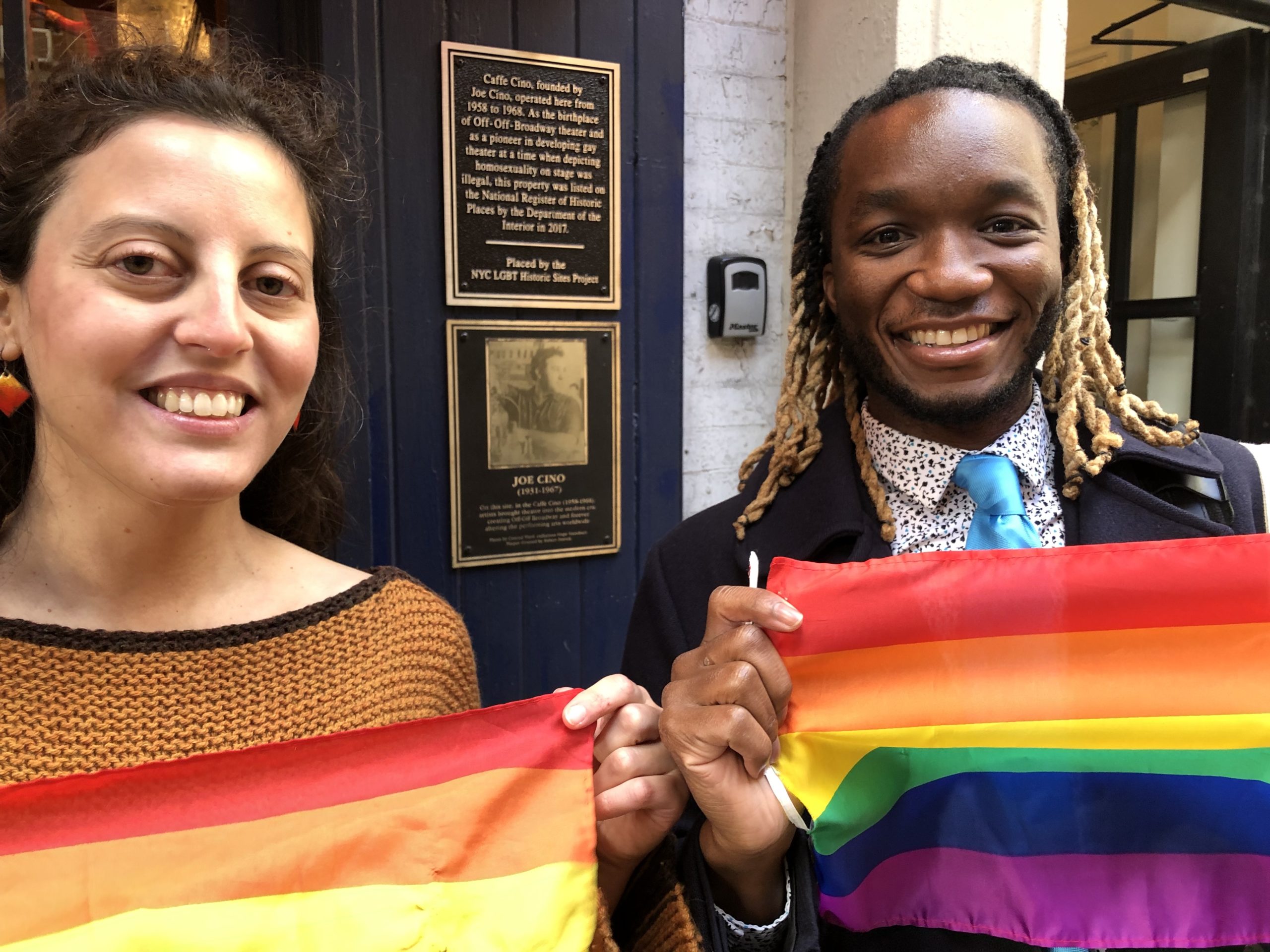
In 2017, we successfully listed the Caffe Cino building to the National Register of Historic Places, in recognition of its significance as the birthplace of Off-Off-Broadway and as a pioneer in the development of gay theater at a time when depicting homosexuality on stage was illegal. The Caffe Cino is one of my favorite sites that I’ve ever researched – a wonderfully quirky, vibrant, and touching story that comes right out of the pages of what Greenwich Village must have been like during the 1960s. For most of the 20th century, this area was very Italian, something that Joe Cino would use to his advantage when he stood here, in December 1958, with his then-boyfriend, Ed, who showed Joe a “for rent” sign on the storefront space at 31 Cornelia Street and introduced him to the landlady, Mrs. Leema, who was looking out her upstairs window. Once they made the connection that she was Italian and Joe was Sicilian, Mrs. Leema said, “I don’t even have to come down, I’ll throw the keys.” And from there, Joe said, in his only known interview, he and Ed “went in and viewed the ruins.” He saw the potential in the tiny room, already envisioning where the counter and coffee machine would go.
The Caffe Cino opened soon after and by 1960, plays were being staged. A year later, playwright Doric Wilson helped establish the Cino as a venue for new work with four plays – two of which included gay themes. The Cino’s breakthrough hit came in 1964 with the staging of Lanford Wilson’s The Madness of Lady Bright, which was centered on an aging drag queen slowly going mad alone in his room. It was so popular that within a year, the Caffe became particularly well known for presenting gay or gay-friendly works. The most successful production here was Dames at Sea, which introduced teenager Bernadette Peters in 1966.
It’s impossible to tell the Cino’s whole story today or even mention the impressive list of theater artists associated with it, but perhaps it’s best summed up by saying that the Cino was a place where Joe Cino encouraged anyone to write about anything they wanted. For gay playwrights, in an era of widespread homophobia, this provided a level of freedom to write gay-themed work at a level never before experience on the New York stage. The Caffe Cino is, as I like to say, a true testament to the arts as a powerful platform for change. In the 1960s, before the Stonewall Uprising and the Gay Liberation era led to increased visibility for LGBT people, gay theater artists at the Cino gave audiences rare public exposure to multi-dimensional and realistic gay characters, and, in doing so, challenged the negative and stereotypical portrayals that had permeated
mainstream theater and film for decades. What we see on stage or on screen very often affects how we view each other and even view ourselves. Although the Cino closed in 1968, following the tragic suicide of Joe Cino a year earlier, the gay theater that it had nurtured continued to evolve with the emergence of gay theater companies, some of which were founded by Cino alums.
We’re honored to be able to unveil the National Register plaque on what would be Joe Cino’s 91 st birthday, and also celebrate the return of the plaque donated by playwright Robert Patrick in 2008.
Pictured, Amanda Davis with Tevin Williams, representing State Sen. Brad Hoylman.
NYC’s Oldest Gay Bar May Soon Get Landmark Status
November 16, 2022
By: Sharon Crowley
from Fox 5
Regulars at Julius Bar in Greenwich Village are eager for the city of New York to designate the tavern as a local historical landmark.
“It’s really important to have the city recognize Julius as a city landmark,” said Ken Lustbader, the co-director of the New York City LGBT Historic Sites Project.
The Stonewall Inn was cemented as the birthplace of the gay rights movement in the U.S. because of the infamous uprising there in 1969. But what many people don’t know is that in 1966 a group of gay men staged an earlier protest trying to get served at the counter.
NYC’s Oldest Gay Bar May Soon Get Landmark Status
November 16, 2022
By: Rana Novini
from NBC News New York
A bar since 1864, Julius’ was thrust into the forefront of the gay rights movement in 1966 — three years before the Stonewall riots — when activists staged a peaceful “sip in,” announcing they are homosexuals and asking to be served
Andrew Dolkart, with the NYC LGBTQ Historic Sites Project, is one of the people fighting for Julius’ Bar to get a city landmark designation. He said it would formalize the bar’s significance in New York and American history.
“These young men who took part in this event, this was incredibly courageous,” said Dolkart. “We need to know where we’ve been, where we are and where we need to go.”
The city’s Landmarks and Preservation Committee held a public hearing Monday where many spoke about why the Greenwich Village mainstay should be recognized. For now, the bar waits, but Adan is already planning the celebration.
There was no opposition to the proposal at the hearing. For the next step, the commission will schedule a public hearing for a vote.
Plaque Unveiling for Caffe Cino
November 16, 2022 | 2:30 PM
Bombay Bistro (former home of the Caffe Cino)
31 Cornelia Street
View on Google Maps
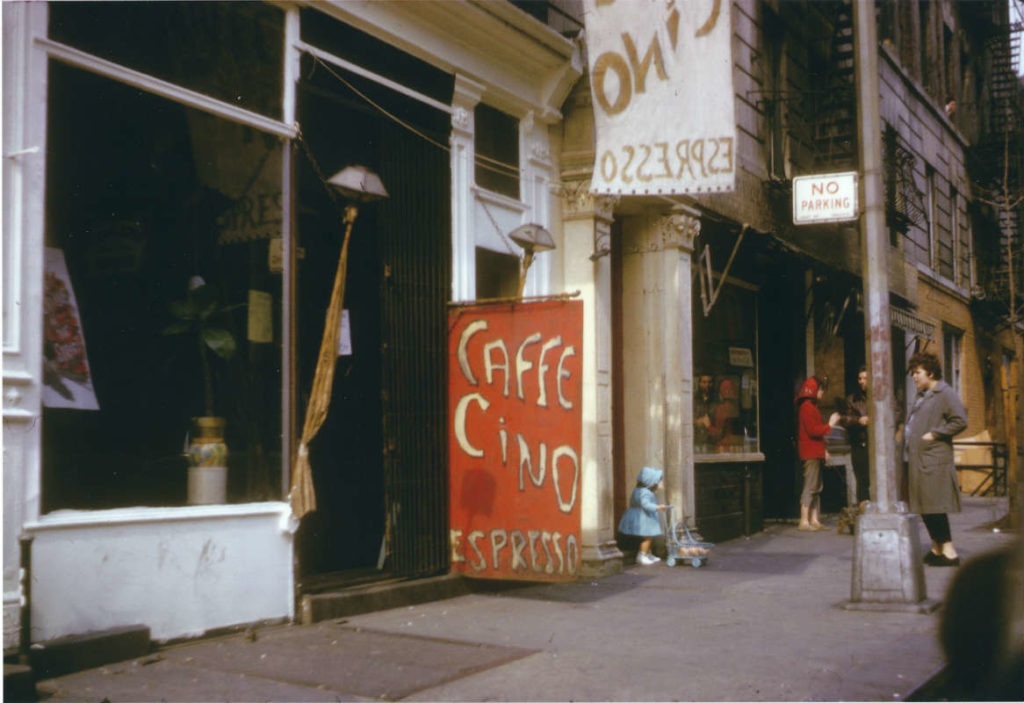
The Caffe Cino operated from 1958 to 1968 and was owned by Joe Cino, an openly gay man. The cafe theater venue is recognized as the birthplace of Off-Off-Broadway and was a pioneer in the development of gay theater, at a time when depicting homosexuality on stage was still illegal. In 2017, the NYC LGBTQ Historic Sites Project successfully nominated the Caffe Cino space to the National Register of Historic Places for its significance to LGBT history.
We invite you to celebrate the Caffe Cino with us as we unveil a plaque at 31 Cornelia Street in Greenwich Village, its former home, on what would have been Joe Cino’s 91st birthday. The plaque recognizes the Cino’s listing on the National Register. We’ll be joined by Bombay Bistro, the current tenant of the space, Magie Dominic, a Cino alum whose archives were invaluable in writing the National Register nomination, as well as a number of special guests.
You can read more about the Caffe Cino on our project page. We hope to see you there!
Audre Lorde’s New York
November 8, 2022
By: Amanda Davis
Last month, I participated in “A Celebration of Audre Lorde,” a virtual event that was hosted by the College of Staten Island. The evening was full of wonderful remembrances and discussions of Lorde and her work. This year marks a couple of anniversaries related to the self described “Black, lesbian, feminist, mother, poet warrior”: she moved to Staten Island 50 years ago with her family and, after a hard fought battle with breast cancer, she died 30 years ago this November 17th. (October was chosen for the event to coincide with Breast Cancer Awareness Month; it’s also LGBT History Month).
My portion of the evening focused on historic places on our website that connect to Lorde’s legacy. Here’s a little snapshot of Audre Lorde’s New York:
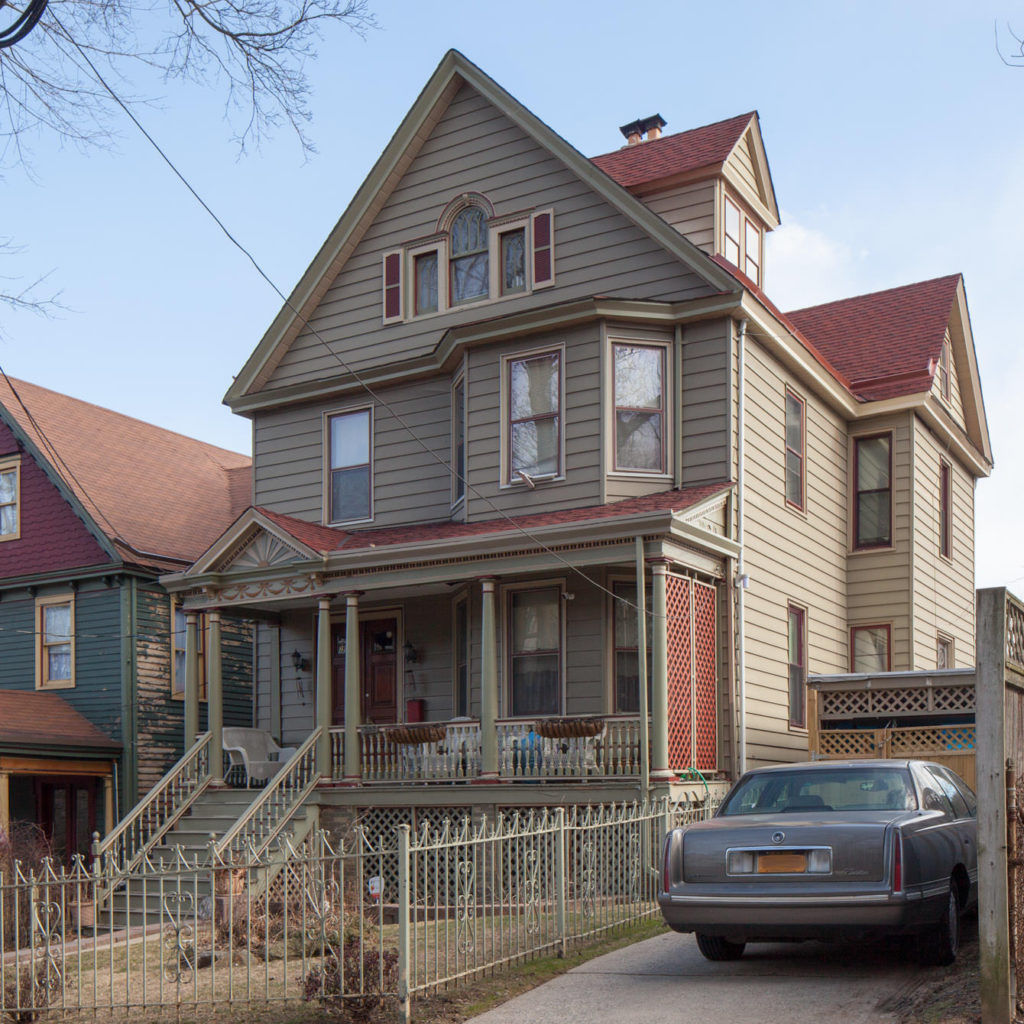
Audre Lorde bought this house at 207 St. Paul’s Avenue in Stapleton Heights in 1972 and lived here with her partner Frances Clayton and two children. The family unfortunately dealt with racism while living here but Lorde also noted that the home’s garden, trees, and proximity to the water were some of the reasons she chose to move to Staten Island. A photo taken by Joan E. Biren (JEB) shows Lorde writing away at her desk in her upstairs study. This is where she wrote some of her most famous work, including (but not limited to) Zami: A New Spelling of My Name (1982). She and her family lived here until 1987. Read more about Lorde’s connection with this house.
One of our Project’s goals is to expand the number of designated LGBT landmarks in New York City. In a meeting with the NYC Landmarks Preservation Commission (LPC), the city agency that designates and regulates the city’s landmarks, we advocated that this house, along with several others, become a New York City Landmark. After a public hearing in June 2019 — where we, of course, testified in support! — LPC commissioners voted to designate the house and five other sites, making Lorde’s home the first LGBT-related New York City Landmark outside Manhattan.
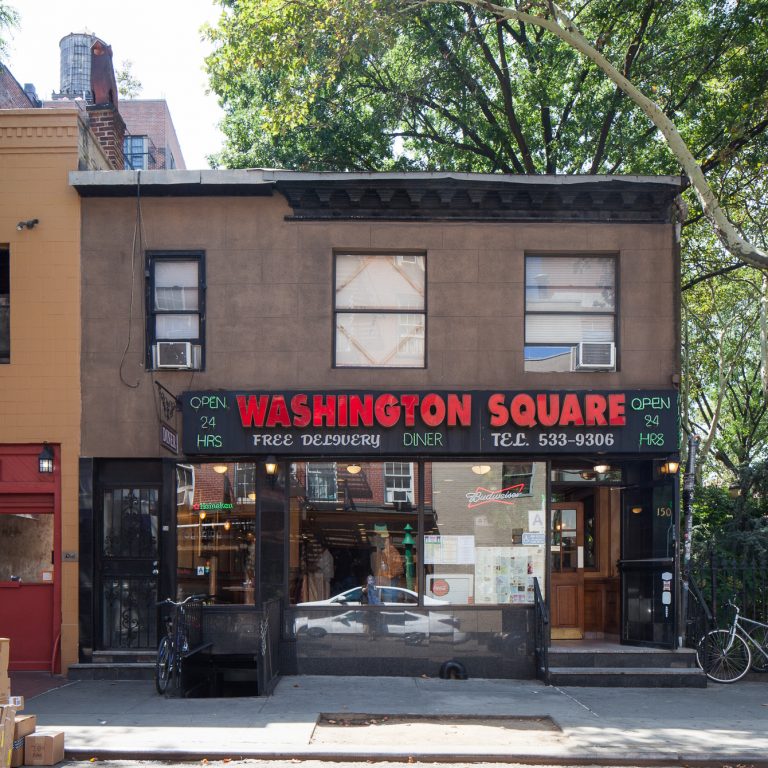
In Zami, Lorde wrote of several lesbian bars in Greenwich Village that she frequented in the 1950s, providing an invaluable account of nightlife in this period for lesbians in general and Black lesbians in particular. Of the Pony Stable Inn at 150 West 4th Street, she noted that “There were always rumors of plainclothes women circulating among us, looking for gay girls with fewer than three pieces of female attire. That was enough to get you arrested for transvestism, which was illegal.”
Bars historically were safe spaces for the LGBT community, but there were also risks involved. We’ve created a curated theme on Bar Raids and Forced Closures that puts this into context.
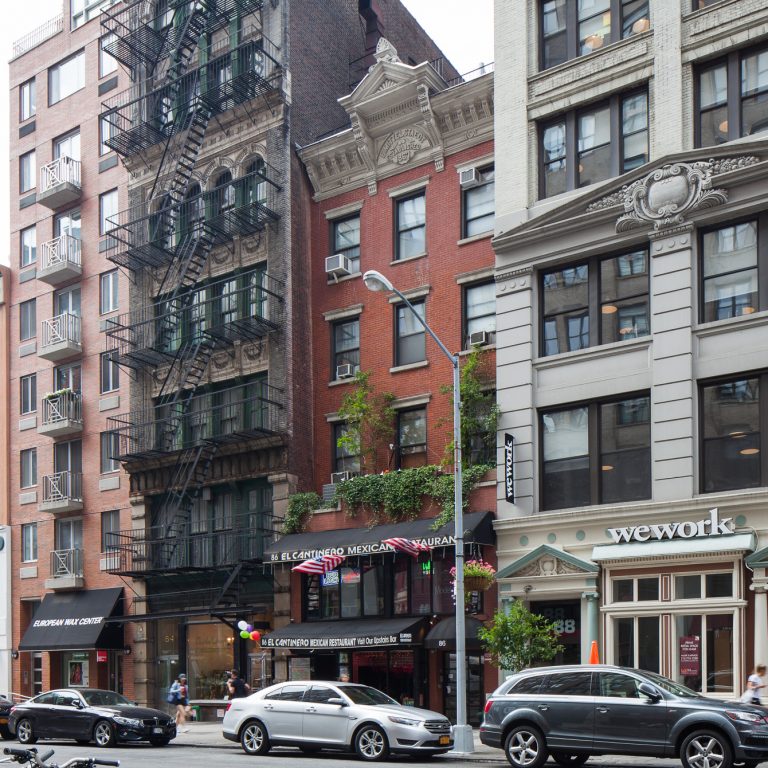
Several lesbian women we’ve spoken to fondly recall The Bagatelle at 86 University Place. Lorde referred to it in Zami as “the most popular gay-girl’s bar in the Village” but, at the same time, many Black lesbians did not feel welcome there. She recalled, “the bouncer was always asking me for my ID to prove that I was twenty-one…Of course ‘you can never tell with Colored people.'”
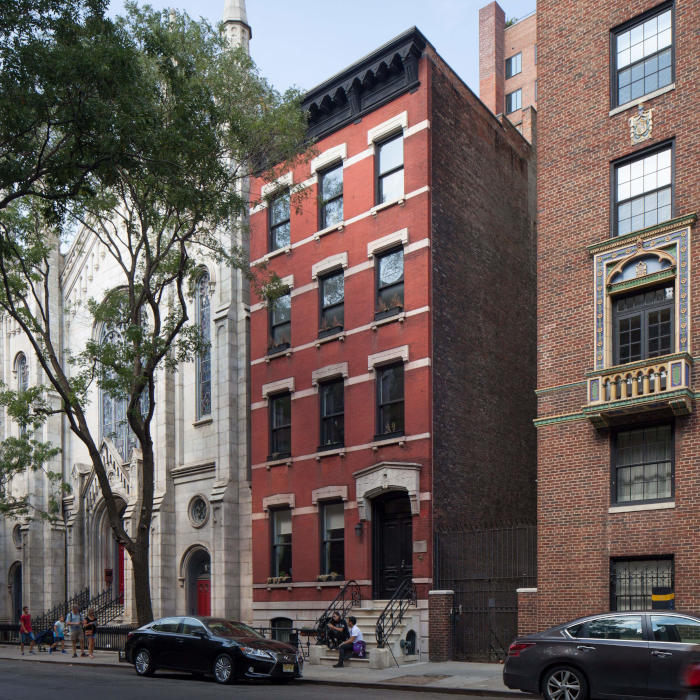
This is what made groups like the Salsa Soul Sisters so important to lesbians of color, providing an alternative to bars where they had historically faced discrimination. Black lesbian luminaries like Audre Lorde were invited to speak on various topics, creating a space that was rare for lesbians of color in 1970s America, according to member Candice Boyce.
The group grew out of the Black Lesbian Caucus of the Gay Activists Alliance, which met at the GAA Firehouse in SoHo in the early 1970s. Salsa Soul’s first regular meeting space was the Metropolitan-Duane United Methodist Church (now Church of the Village) but its longtime home was in the parish house of Washington Square Park United Methodist Church.
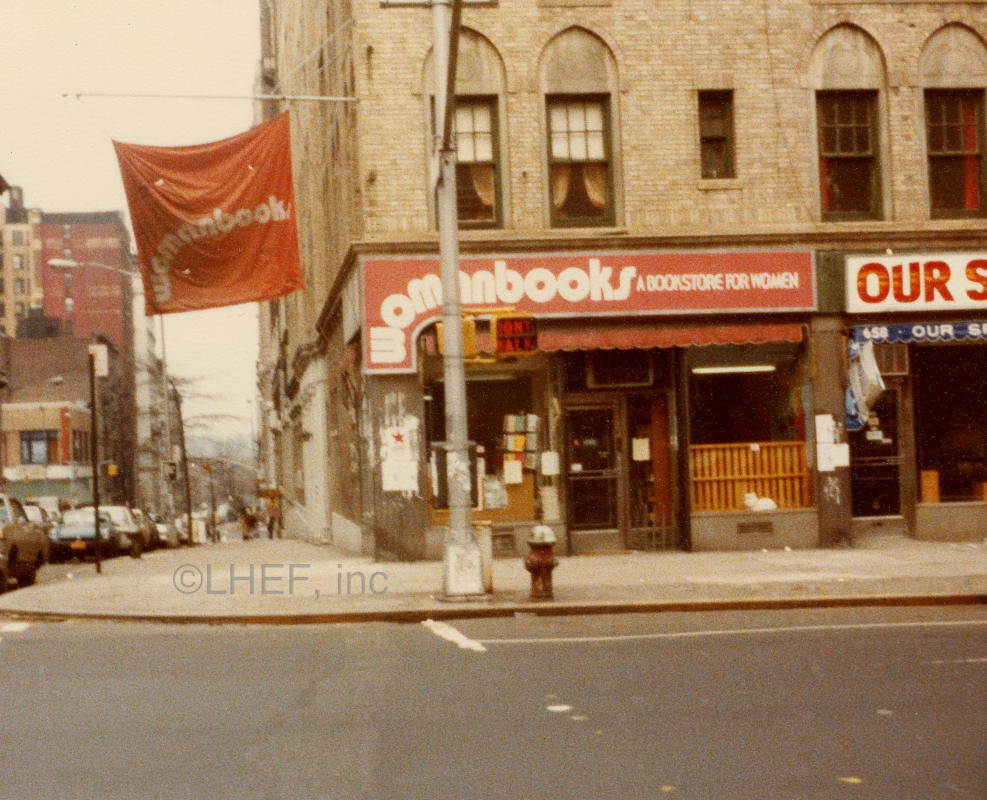
Let’s end with an archival photograph (always my favorite!) of Womanbooks, which was located at 201 West 92nd Street on the Upper West Side from 1975 to 1987. The bookstore doubled as a community center for women regardless of sexuality, race, or political affiliation, and was another one of several places in the city where Audre Lorde spoke to lesbian audiences.
What are some of the other places where she made her mark in the city? Type her name in the search bar at the top of the website or watch the recording of “A Celebration of Audre Lorde” below. Participants include faculty and students of the College of Staten Island, Debbie-Ann Paige of the Staten Island African American Heritage Tour, and Victoria Munro of the Alice Austen House who spoke with Lorde’s sister comrades.
NYC LGBTQ historic sites project receives ‘excellence’ award
November 6, 2022
By: Lou Chibbaro Jr.
from the Washington Blade
The National Trust for Historic Development has chosen the New York City LGBT Historic Sites Project as the recipient of its Trustees Award for Organization Excellence.
The LGBT Historic Sites Project is one of nine historic preservation-related organizations that were recognized with awards at a Nov. 4 virtual ceremony that was available to the public.
“The NYC LGBTQ Historic Sites Project is a nationally recognized and influential cultural heritage initiative and educational resource that identifies and documents diverse extant LGBT sites from the 17th century to 2000,” the announcement says.
See the full article by the Washington Blade.
Featured thumbnail via Washington Blade file photo by Michael Key.
NYC LGBTQ Historic Sites Project To Receive Prestigious Trustees’ Award From the National Trust for Historic Preservation
November 4, 2022
By: A.A. Cristi
from Broadway World
The NYC LGBTQ Historic Sites Project’s work to identify and document NYC’s place-based LGBT history is being honored by the National Trust for Historic Preservation today, Friday, November 4th, at 4PM EST with their Trustees’ Award for Organizational Excellence, one of our field’s highest honors. The award will be given at the PastForward Conference, in a ceremony hosted by old house icon Bob Vila.
NYC LGBTQ Historic Sites Project honored with award for ‘making a once invisible history visible’
November 5, 2022
By: Muri Assunção
from the New York Daily News
A New York City nonprofit that focuses on documenting sites that are connected to the city’s rich LGBTQ history and culture has been recognized for its “trailblazing approach to making a once invisible story visible.”
The NYC LGBTQ Historic Sites Project on Friday received the Trustees’ Award for Organizational Excellence from the National Trust for Historic Preservation, a Washington, D.C.-based nonprofit that works in the field of historic preservation in the United States.
The award, which honors “superlative and continued achievement in historic preservation by an organization,” was presented to Ken Lustbader, the organization’s co-founder and co-director.
Exploring LGBT Historic Sites in Queens
October 20, 2022 | 6:00 PM
Amanda Davis, project manager of the NYC LGBTQ Historic Sites Project, will introduce attendees to the multilayered LGBTQ histories embedded in New York City’s built environment, with a special focus on sites located in the borough of Queens. She will also discuss how her organization works both to preserve these sites and present them to the public.
This live virtual presentation will be moderated by Aithne Bialo-Padin, Lecturer in the Department of History at Queensborough Community College / CUNY.
A Celebration of Audre Lorde
October 27, 2022 | 6:30pm
Project manager Amanda Davis will take part in this virtual event hosted by the College of Staten Island. From the College’s event description:
Please join us to celebrate the life, work, and accomplishments of Audre Lorde – Black poet, writer, radical feminist, Womanist, lesbian, and human rights activist – on the 30th anniversary of her death and the 50th of her moving to Staten Island with her partner Frances Clayton and two children. Audre Lorde lived in the Stapleton Heights neighborhood for 17 years, teaching at Hunter College and producing some of her most important work. Faculty members from the College of Staten Island and community partners and friends will make brief presentations about the many dimensions of Lorde’s life, work, and legacy. In addition, students from the College will read and reflect on the significance of Lorde’s poetry in their lives today. In addition, clips of Audre Lorde reading and speaking will be presented. The event will conclude with questions, comments, and reflections from audience members. Please note: Advance registration is required for this event; register at tinyurl.com/csialcelebration
This event is co-sponsored by the College of Staten Island School of Education, Department of the Library, Department of English, Office of Student Life – LGBTQ Resource Center/Pluralism & Diversity, Bertha Harris Women’s Center, and the Women’s, Gender & Sexuality Studies Program. We are especially grateful for the participation of the Alice Austen House Museum, NYC LGBTQ Historic Sites Project, and the Staten Island African American Heritage Tour.
“Homos, Lezzies, and Undesirables”: Gay Bar Raids and Closures in NYC
June 21, 2022 | 6:30PM
In the 19th and 20th centuries, gay and lesbian bars and clubs were subject to various oppressive forms of social control by the police, religiously-affiliated individuals and groups — such as the 19th-century New York Society for the Suppression of Vice, that dictated morality and raided bars and clubs — and eventually the State Liquor Authority (SLA) in 1934. After the end of Prohibition, almost all LGBT bars and gathering spaces came to be controlled by the Mafia. In this talk, co-director Jay Shockley will highlight locations that were routinely raided by the police and the acts of civil disobedience activists organized in response, such as the Sea Colony, a 1950s-60s lesbian bar; Julius’, now known for the Mattachine Society’s 1966 “Sip-In”; and more.
REGISTER HERE>
This event is presented with the support of the New York Community Trust and Con Edison.
Photo: The Sea Colony, first floor of 52, 50, and 48 Eighth Avenue (left to right), 1964. Photo by John Barrington Bayley. Courtesy of the NYC Landmarks Preservation Commission.
A Visit to Ferncliff Cemetery
October 24, 2022
By: Amanda Davis
Happy LGBT History Month! A couple of weeks ago, I visited Ferncliff Cemetery in Hartsdale, New York, just north of the city in Westchester County. It’s a place I’ve been wanting to visit for a few years now because it’s where writer and activist James Baldwin is buried.
Before my mother and I drove to the cemetery, I looked up the “Celebrities & Notables” list on Ferncliff’s website to see who else we might visit. It’s a pretty impressive list!
LGBT notables there that we didn’t visit, due to time constraints, include society leader Elsa Maxwell (1883-1963), actress Ona Munson (1910-1955), who played Belle Watling in Gone with the Wind (1939), and novelist Cornell Woolrich (1903-1968). Also of note is Conrad Veidt (1893-1943), a straight actor who starred in what is believed to be the world’s earliest pro-gay film, the German silent movie Different from the Others (1919). It was co-written by sexologist Magnus Hirschfeld, who is not buried at Ferncliff but whose 1930s visit to New York City is mapped on our website. Gay icon Judy Garland (1922-1969) was interred at Ferncliff until 2017, when she was moved to Hollywood Forever Cemetery in Los Angeles at the request of her daughter, Liza Minnelli.
The following three people from Ferncliff’s list of notables — all pioneering LGBT African Americans — are featured on our website. With Pride flag in hand, my mother and I navigated our way around the cemetery to pay our respects on what turned out to be a picture-perfect October day.
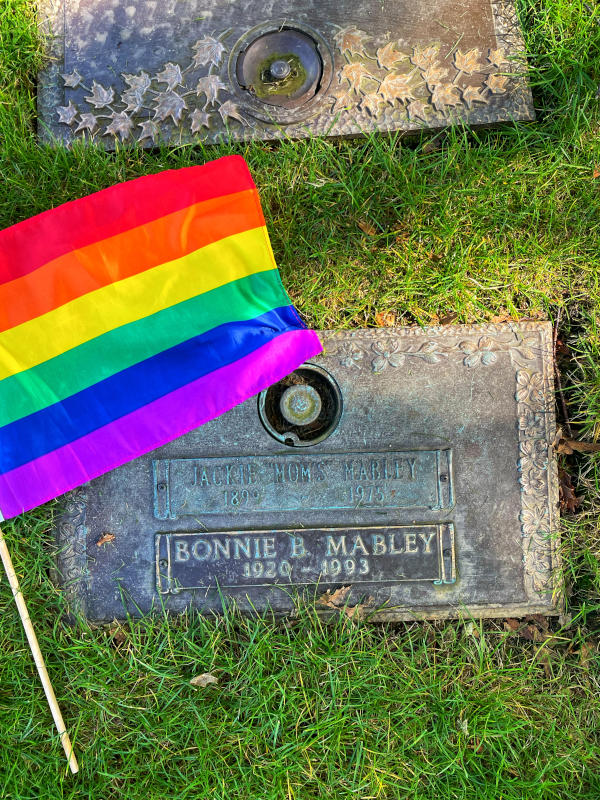
The first gravesite we visited was Jackie “Moms” Mabley (1899-1915), a stand-up comedian in the mid-20th century who was known as “The Funniest Woman in the World.” She is mentioned in two places on our website: the Apollo Theater in Harlem, where she is credited as the first woman to headline a performance there, and the Ed Sullivan Theater in Midtown, where she appeared on The Ed Sullivan Show in the 1960s.
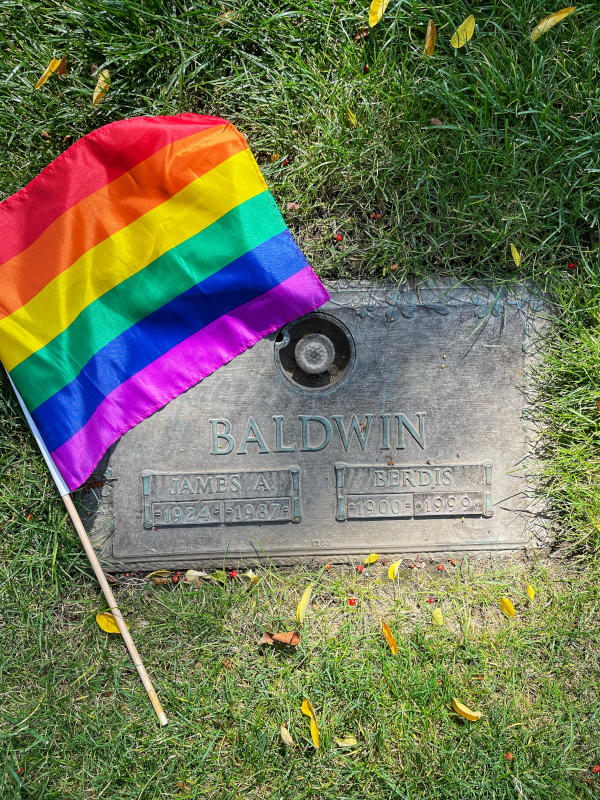
We next visited novelist and civil rights activist James Baldwin (1924-1987). He is featured in several places on our website, including his Upper West Side residence, which we successfully nominated to the National Register of Historic Places in 2019 for its significance to Black and LGBT history. The rowhouse at 81 Horatio Street in Greenwich Village, where he lived from 1958 to 1961, was where he worked on his third novel, Another Country (1962). This December will mark the 35th anniversary of his death.
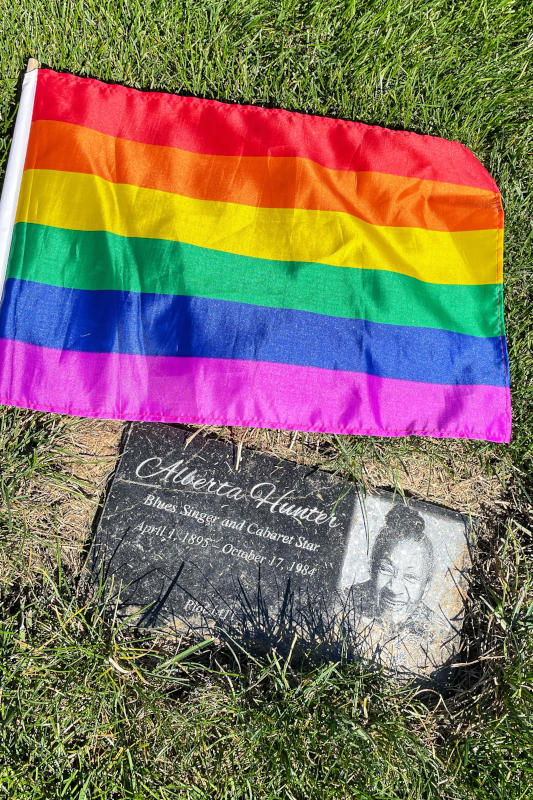
Our last stop was the gravesite of blues legend Alberta Hunter (1895-1984). She is featured in several places on our website, including her Harlem residence at 133 West 138th Street, which she owned from 1927 until at least 1945, and the Apollo Theater, where she performed.
I almost thought we weren’t going to find her because when we followed the grave numbering system the spot where she should have been was just a patch of grass. We looked in several other places and then, when I was just about to call it a day, I looked to my right and saw her smiling face looking back at me! If you’d like to visit her just know that she’s in the same row that you’d think she’d be (if you follow the numbering system) but she’s a bit further down to the left. We also shared a quick clip of the Pride flag swaying in the breeze by her gravesite on our Instagram page to commemorate the anniversary of her death on October 17th.
More Cemetery Tributes
The NYC LGBTQ Historic Sites Project team loves paying tribute to LGBT people in their final resting places. Co-director Jay Shockley and I visited Congressional Cemetery in Washington, D.C., last month to visit the likes of gay rights leaders Frank Kameny, Barbara Gittings, Kay Lahusen, and Leonard Matlovich, as well as Alain Locke, known as the “Dean” of the Harlem Renaissance. You can catch our Instagram Reel from that trip.
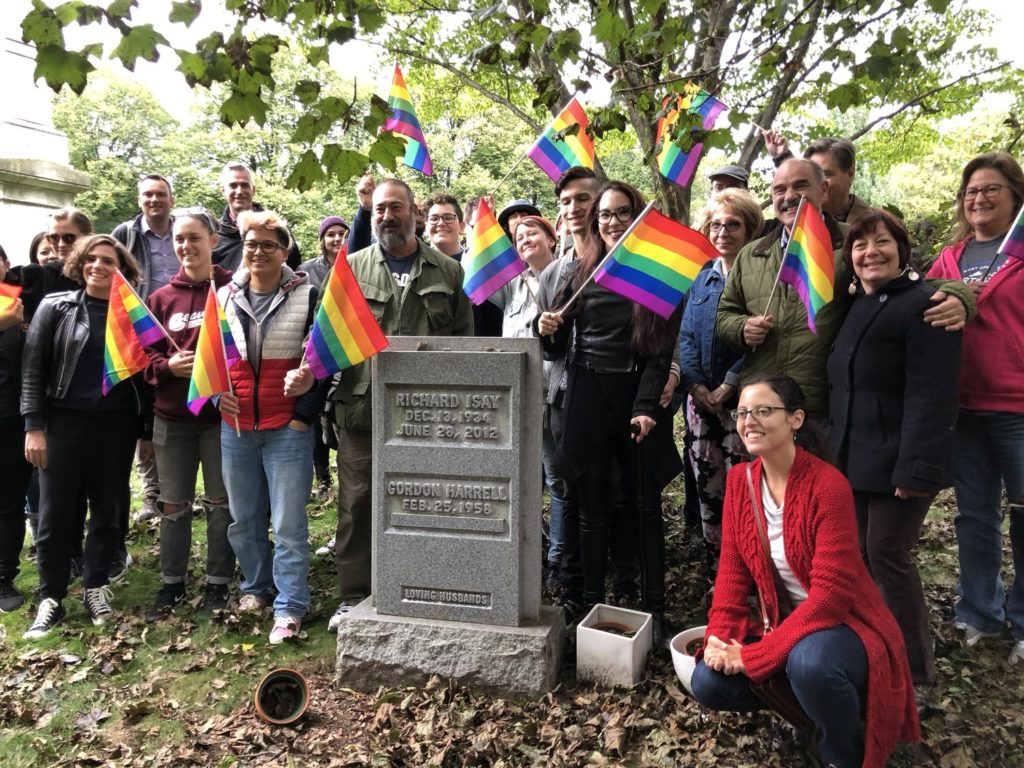
Want to join us in the future? We lead cemetery tours annually at Green-Wood Cemetery in Brooklyn and Woodlawn Cemetery in the Bronx and place Pride flags at the gravesites of LGBT notables. These are typically held in either the spring or the fall and are always very moving and popular events. Follow us on social media (@nyclgbtsites) or subscribe to our email list (sign-up box below) to be the first to know the next time we schedule an outing.
In Support of Lesbian Herstory Archives NYC Landmark Designation
October 20, 2022
to be presented at public hearing on October 25, 2022
Testimony in Support of the Proposed Designation of the
Lesbian Herstory Archives, 484 14th Street, Brooklyn,
as a New York City Landmark
Tuesday, October 25, 2022
My name is Amanda Davis and I am the project manager of the NYC LGBTQ Historic Sites Project, a cultural heritage initiative founded by historic preservationists in 2015 to document historic places connected to the lesbian, gay, bisexual, and transgender community in the city’s five boroughs.
The Project strongly supports the designation of the Lesbian Herstory Archives as a New York City Landmark, the first LGBT historic site to be designated in Brooklyn. When we launched our website with an inaugural 100 sites, the Lesbian Herstory Archives was included. Founded in 1974 in the Upper West Side apartment of Joan Nestle, the Archives bought its current Park Slope rowhouse in 1991, officially reopening in June 1993. The purchase ensured that the Archives would have a permanent space, which continues to serve the lesbian community today. Its resources, particularly its archival photographs, have been invaluable to our Project in documenting many of the over 400-plus sites on our website.
With a history that spans nearly fifty years – thirty of those years in Park Slope – the Lesbian Herstory Archives is likely the first, long-standing, lesbian-specific community space in New York City. It is also an early example of a group run by and for lesbians. The Archives was born out of a need to provide a voice for lesbians, who often felt underrepresented and unheard in gay male-dominated groups, and to connect emerging lesbian artists and writers with more established ones, at a time when lesbians were less visible in mainstream culture. Access to previously unknown lesbian-affirming literature, ephemera, and other archival items has also empowered women and linked them with their past. Archives coordinator Saskia Scheffer once noted that “Most people would throw everything out about lesbians, or only keep the negative things. … But the Archives house the collective memory of what happened to us as a group.”
The Lesbian Herstory Archives’ location in Park Slope also speaks to the importance of the neighborhood to LGBT history. By the 1990s, Park Slope was popular with lesbians and their families as a place to live and find community, and several lesbian-associated groups and businesses, including the Archives, operated there. As a result, the designation of the Lesbian Herstory Archives building as a New York City Landmark would also highlight and celebrate Park Slope’s historic significance to the lesbian community.
The NYC LGBTQ Historic Sites Project proudly supports this proposed designation.
Thank you.
City takes first step toward landmarking Julius’ Bar
September 13, 2022
By: Maya Rajamani
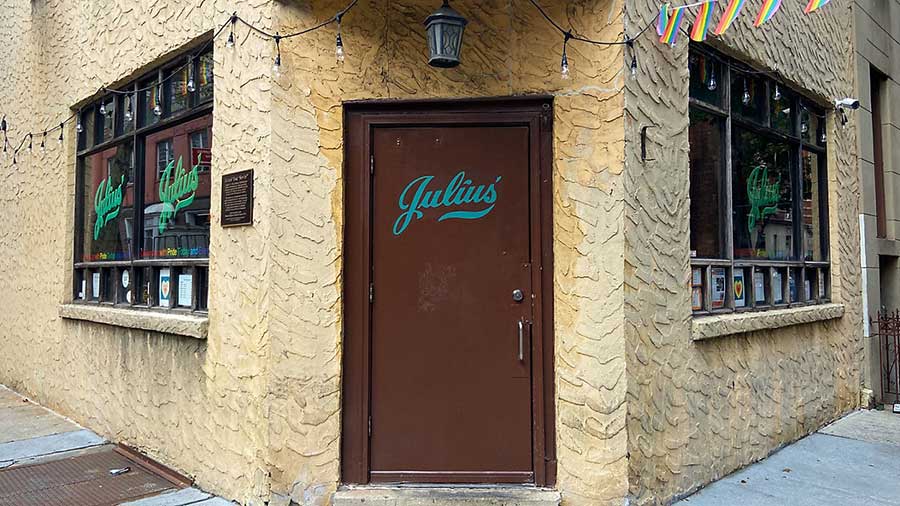
The oldest gay bar in the five boroughs, Greenwich Village stalwart Julius’ Bar, is on track to become a New York City landmark.
Members of the city’s Landmarks Preservation Commission unanimously voted during a public hearing Tuesday morning to “calendar” the West 10th Street building that houses the bar.
In 1966, the bar was the site of what was called a “Sip-In,” a protest against regulations that made it illegal to serve people suspected of being gay or lesbian.
“Calendaring” a site, or scheduling a public hearing to discuss its significance, is the first official step in the process of designating a landmark, according to the LPC.
“We have staff working specifically on identifying sites that are significant to the LGBTQ community and heritage in the city,” LPC Chair Sarah Carroll said at the hearing. “And this has always been one that we have been thinking about.”
The commission will hold the public hearing “in the near future this fall,” Carroll added, without providing an exact date.
Built in the early 1800s as a trio of standalone buildings that were later combined, the Arts and Crafts style building “has housed a bar since the 1860s,” LPC Director of Research Kate Lemos McHale said at the hearing.
The present-day Julius’ Bar at 159 West 10th St., at the corner of Waverly Place, opened its doors in 1930, she said.
In the 1950s, the watering hole became a popular gathering place for gay men, “despite its management’s unwelcoming attitude toward them, mixing in among the bar’s mostly straight clientele,” she added.
By the early 1960s, the city had begun taking steps to crack down on bars and restaurants that served gay people, as the State Liquor Authority had deemed serving them illegal. A police raid stemming from that crackdown sparked the 1969 Stonewall Uprising, which served as a turning point for the city’s LGBTQ rights movement.
Three years before Stonewall, however, three members of the Mattachine Society — a gay rights organization — made history by holding a “Sip-In” at Julius’ Bar.
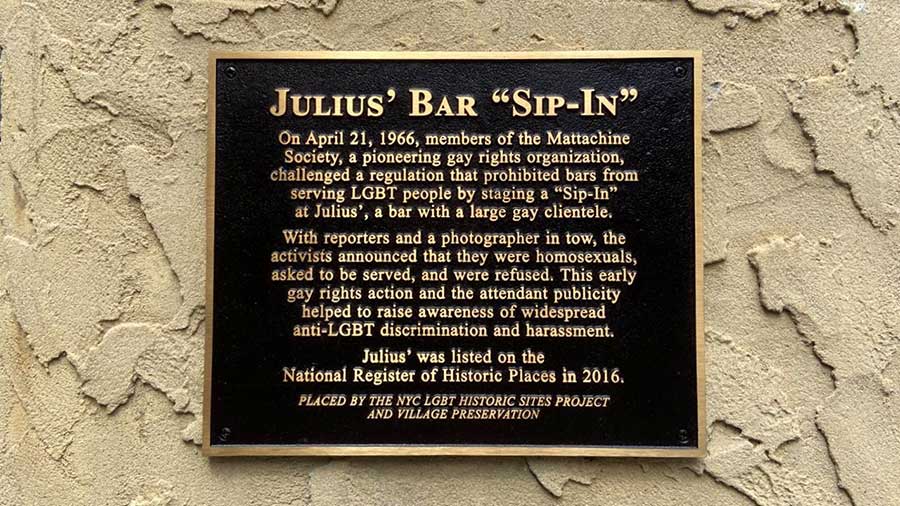
“With reporters and a photographer in tow, the activists announced that they were homosexuals, asked to be served, and were refused,” a plaque Village Preservation and the NYC LGBTQ Historic Sites Project fastened to the bar’s facade earlier this year reads.
“This early gay rights action and the attendant publicity helped to raise awareness of widespread anti-LGBT discrimination and harassment,” it adds.
While the National Register of Historic Places listed Julius’ Bar in April 2016, Tuesday’s hearing marked the first time the city has formally considered landmarking it.
In a press release Tuesday morning, Village Preservation said the LPC’s vote followed a “nine-year campaign” to see the bar become a city landmark.
The LPC designated the Stonewall Inn a landmark in June 2015.
“This is a tremendously important step toward conferring much-needed recognition and protection upon this site, which played such an enormously important role in the LGBTQ+ civil rights movement,” Village Preservation Executive Director Andrew Berman said in a statement.
“LGBTQ+ and civil rights history like that which is embodied in Julius’ Bar are essential elements of our collective story, and it’s critical that they not be forgotten or erased,” Berman added.
Julius’, New York City’s oldest gay bar, is one step closer to becoming a city landmark
September 13, 2022
By: Devin Gannon
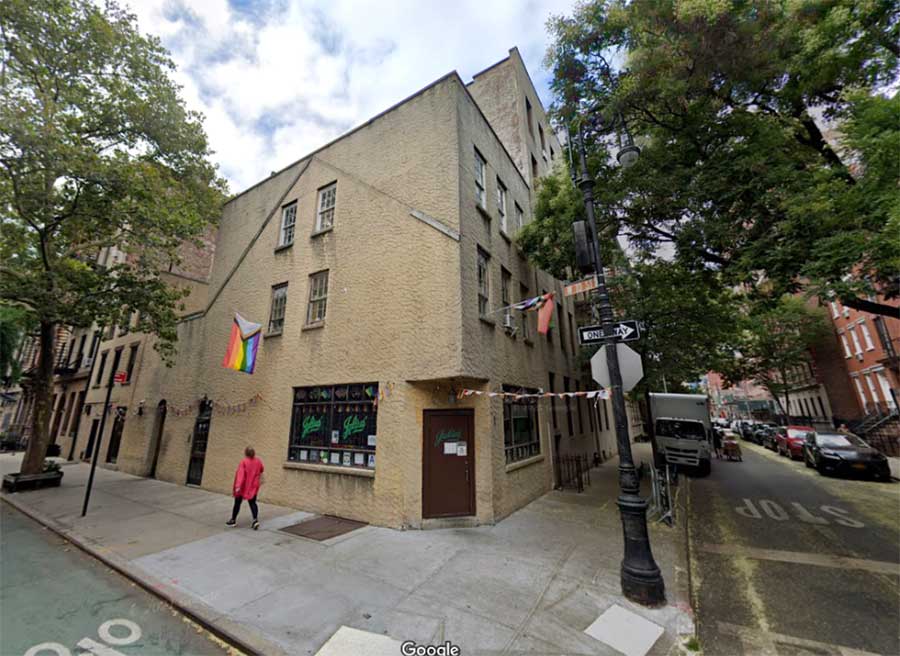
New York City’s oldest gay bar is on its way to becoming an individual landmark. The Landmarks Preservation Commission on Tuesday voted to calendar Julius’ Bar, a Greenwich Village establishment known for its historic 1966 “Sip-In” when members of the Mattachine Society protested the state law that prohibited bars from serving “suspected gay men or lesbians.” Considered one of the city’s most significant sites related to LGBTQ+ history, Julius’ Bar played an instrumental role in advancing the rights of gay New Yorkers.
Located on the corner of West 10th Street and Waverly Place, the building that is now home to Julius’ was constructed in the early 19th century as three separate structures that were later combined into one building. The property has held a bar since the 1860s; Julius’ Bar opened in the 1930s. By the 1960s, gay men started meeting at the bar, despite “unwelcome attitudes.”
On April 21, 1966, three years before the Stonewall Riots, members of the gay rights group the Mattachine Society organized a “Sip-In,” a non-violent protest inspired by the sit-ins of the Civil Rights Movement. The purpose of the sip-in was to challenge the New York State Liquor Authority rules put into effect so bars could not serve drinks to known or suspect gay men or lesbians.
According to the NYC LGBTQ Historic Sites Project, Dick Leitsch, Craig Rodwell, and John Timmons visited several bars, announced that they were “homosexuals,” and ordered a drink. At Julius’, the group was refused. The demonstration led to a court ruling a year later that determined gay people had the right to assemble and be served alcohol, and over time, the growth of bars as social spaces for the LGBTQ+ community.
While the building that houses Julius’ Bar has seen changes over time, including its Arts and Crafts style stucco facade from the 1920s. After structural issues were discovered in the 1980s, the building was “essentially reconstructed with the same appearance,” according to the LPC, with a “restorative approach” approved by the commission. Small changes include the bar’s window openings, replacement of pattern brickwork, and the addition of a faux cornice, but it retains its integrity from the period of significance in the 1960s.
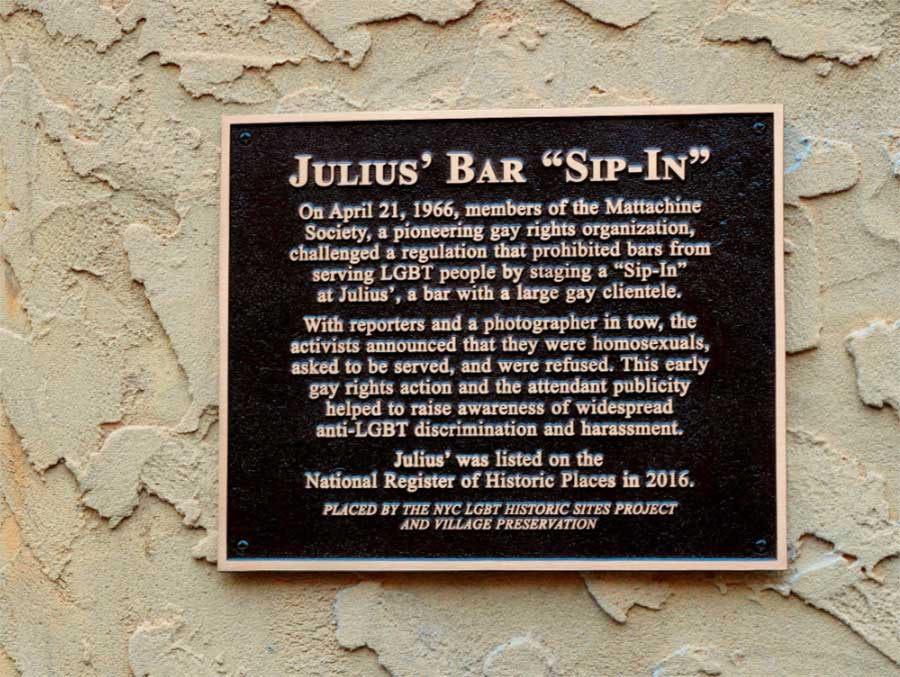
Advocates have pushed for Julius’ to be recognized for its significance. Thanks to an effort led by the NYC LGBTQ Historic Sites Project, the bar was listed on the New York State Register of Historic Places in 2015 and the National Register of Historic Places in 2016.
Historic preservation group Village Preservation has pushed LPC to designate Julius’ as a city landmark for nearly a decade. In April, Village Preservation and the NYC LGBTQ Historic Sites Project unveiled a plaque at Julius’ Bar to mark the significance of the Sip-In.
“It’s so important that we not only honor sites like these that tell the diverse stories of our city and country’s history and culture but that we take affirmative steps like landmarking to ensure they are forever preserved,” Andrew Berman, executive director of Village Preservation, said in a statement.
“LGBTQ+ and civil rights history like that which is embodied in Julius’ Bar are essential elements of our collective story, and it’s critical that they not be forgotten or erased. We’re very fortunate that Greenwich Village is so rich in these threads of our history, and we’re committed to ensuring they are recognized and preserved, for everyone’s benefit.”
Calendaring a property is the first step in the designation process, followed by a public hearing and a vote.
City to consider landmarking Julius’ Bar
September 13, 2022
By: Matt Tracy
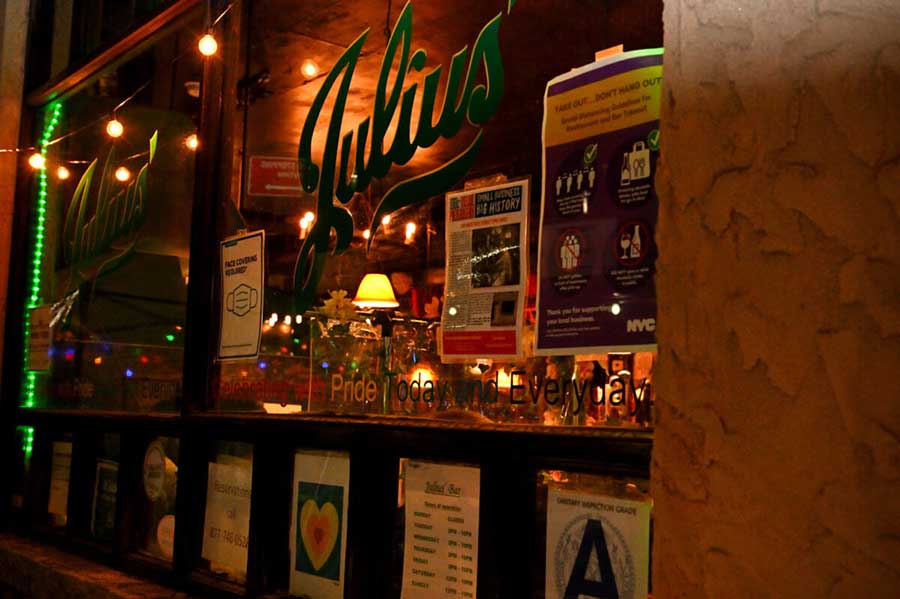
The building housing Julius’ Bar, which is known as the oldest gay bar in New York City and the site of the 1966 “sip-in” event that helped catapult the right to drink for LGBTQ people, could soon be formally recognized as a city landmark.
The New York City Landmarks Preservation Commission (LPC) voted on September 13 to “calendar” — or set up for formal consideration — the bar’s building at 159 West 10th Street in Greenwich Village. The law stipulates that the LPC must hold a hearing and vote on landmarking the building within a year, according to Village Preservation, which is a non-profit organization dedicated to saving the architectural and cultural history of Greenwich Village, the East Village, and NoHo.
Julius’ building holds particular significance in LGBTQ history thanks to the sip-in demonstration that took place on April 21, 1966 — three years before Stonewall — when Mattachine Society members Dick Leitsch, Craig Rodwell, John Timmons, and Randy Wicker challenged the State Liquor Authority’s policy barring bartenders from serving LGBTQ people.
The four individuals, accompanied by the press, entered multiple bars and said, “We are homosexuals. We are orderly, we intend to remain orderly, and we are asking for service.” The first bars they entered were willing to pour them drinks, so they continued on to Julius’ bar, where a bartender placed his hand over a glass to demonstrate his refusal to serve them.
Advocates have long pushed for Julius’ to get landmark designation, which prevents significant changes to the building in the future, but that campaign is largely symbolic because the building that houses Julius’ already sits within the landmarked Greenwich Village Historic District. That area encompasses a collection of more than 2,000 buildings over 100 blocks in Manhattan.
“[Landmarking] the bar is very important because it marked one of the few sites that really predate even Stonewall in the beginning of the movement,” Wicker, a longtime LGBTQ activist, told Gay City News on September 13 as he recalled his role in the sip-in protest.
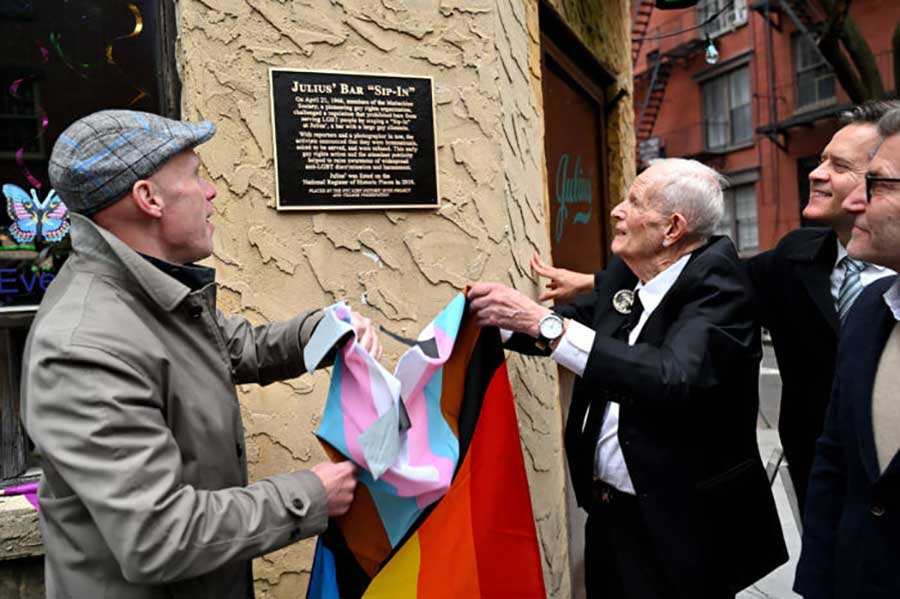
Village Preservation’s executive director, Andrew Berman, said the organization has been a proponent of the push to landmark Julius’ building for nine years.
“This is a tremendously important step toward conferring much-needed recognition and protection upon this site, which played such an enormously important role in the LGBTQ+ civil rights movement,” Berman said in a written statement. “We’re optimistic that it will soon join the ranks of other officially designated LGBTQ+ landmarks in our neighborhood which we fought for…”
Berman, Wicker, and others joined together at Julius’ in April of this year to mark the 56th anniversary of the sip-in. To this day, Wicker remembers walking from bar to bar as he and others sought to bring attention to the state’s discriminatory policy.
“Julius’ didn’t want to be a gay bar,” Wicker said. “In the afternoon, people in the neighborhood would stop in and have a beer and socialize, but because there was a large population of gay people in neighborhood, they had a large clientele. On the weekends, they kept an eye on how many males and females were in the bar because they didn’t want it to tip over into being all male.”
While other bars were willing to look the other way and serve the men regardless of the liquor law, Julius’ was on edge after one man was recently entrapped and arrested prior to the sip-in.
“[Julius’] got notice that the liquor license could be revoked if you got another incident like this, so that was the reason they really refused us,” Wicker added. “Because the police department could do this so they could start getting payoffs from Julius’. The precinct was very corrupt in that way.”
The rise of public-facing gay bars, Wicker said, helped spark further advances for LGBTQ rights and even drew the attention of political figures who started to realize the voting power of queer people in the area.
“Politicians started going to those bars seeking votes,” Wicker said.
Berman welcomed the LPC’s vote to consider the building, but he also emphasized that such designations are also needed for other places that hold significance in LGBTQ history.
“We hope the LPC will also take some not just symbolic actions to landmark LGBTQ+ historic sites currently entirely lacking in protection, which could actually be lost or compromised in some way,” he said, pointing to a list of sites rich with LGBTQ history. Those locations include spots like 55 Fifth Avenue, which was home to Columbia Photograph Recording Studios and OKeh Phonograph Recording Studios and brought in notable LGBTQ performers such as Blues singer Bessie Smith; 86 University Place, which was the site of a popular lesbian bar called “The Bag” and attracted customers such as Audre Lorde; and St. Ann’s Church at 120 East 12th Street, which hosted a funeral mass for trans performer Jackie Curtis in 1985.
The LGBTQ spots already landmarked by the city include the Stonewall Inn, which was landmarked in 2015, as well as six more sites that were designated as landmarks in 2019 — the year New York City hosted WorldPride: Caffe Cino at 31 Cornelia Street, the LGBT Community Center at 208 West 13th Street, the Gay Activists Alliance Firehouse at 99 Wooster Street, James Baldwin’s residence at 137 West 71st Street, the Women’s Liberation Center at 243 West 20th Street, and Audre Lorde’s residence at 207 St. Paul’s Avenue on Staten Island.
“LGBTQ+ and civil rights history like that which is embodied in Julius’ Bar are essential elements of our collective story, and it’s critical that they not be forgotten or erased,” Berman added. “We’re very fortunate that Greenwich Village is so rich in these threads of our history, and we’re committed to ensuring they are recognized and preserved, for everyone’s benefit.”
One of New York City’s oldest gay bars could become city landmark
September 13, 2022
By: Eyewitness News
In April, Village Preservation and the NYC LGBTQ Historic Sites Project unveiled a plaque at Julius’ Bar to mark the significance of the sip-in.
Calendaring a property is the first formal step in the designation process, followed by a public hearing and a vote.
Meet the NYC LGBTQ Historic Sites Project Team at History UnErased’s Virtual Soirée!
September 13, 2022 | 7:30pm - 8:30pm
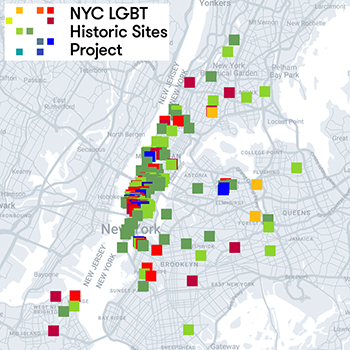 On September 13th (7:30pm-8:30pm) Project co-directors Jay Shockley and Ken Lustbader, and project manager Amanda Davis, will join friends and collaborators at History UnErased for a virtual interactive multimedia soirée and discussion!
History UnErased is an education nonprofit founded in 2015 by veteran classroom teachers to provide K-12 schools with curriculum and training to teach LGBTQ-inclusive history as it intersects with race, gender, and nationality within the mainstream curriculum.
In 2017, the Project was contacted by History UnErased about using its interactive map content as a curriculum tool to further the Project’s goal of bringing LGBTQ historic places to life to reveal a broader story of American history and culture. The Project subsequently presented its work to public school teachers at an NYC Department of Education conference, and began site visits at area schools to bring LGBTQ-centered history around arts and culture, education, science, and more, into the classroom.
Register now to learn more about this history, and to meet people doing vital work toward a mission shared by the NYC LGBTQ Historic Sites Project: Making an invisible history visible.
And don’t forget to come prepared with your favorite sips and snacks!
Exploring History and Advocacy at the People’s Beach at Jacob Riis Park
August 18, 2022 | 12pm - 1pm
Virtual event (Zoom)
Zoom
View on Google Maps
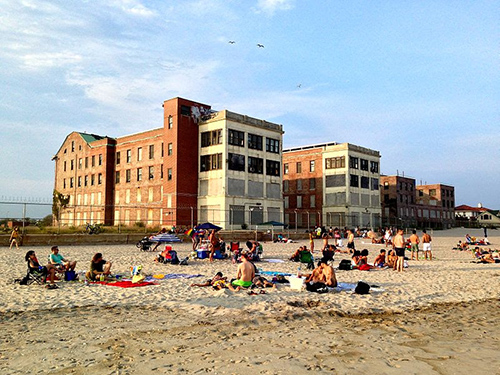
What are spaces of freedom, community, and expression? Do they form naturally, or can we create them? How can we designate, document, and defend these spaces now and in the future?
Join MAS as we explore these ideas with a virtual conversation about the People’s Beach at Jacob Riis Park. The People’s Beach has long been a beloved space for LGBTQ+ New Yorkers. A recently announced city plan threatens to knock down a long-abandoned medical center that helped cultivate this stretch of beach as a safe haven. What would that mean for the beach and its role as a protected place for queer culture, queer history, and queer community?
The conversation will engage artists, historians, journalists, and activists in a discussion on the importance of the space, and how we can document, celebrate, and protect community spaces at Jacob Riis Park, and beyond.
PANELISTS
Ceyenne Doroshow, GLITS
Jahlove Serrano, GLITS
Ken Lustbader, NYC LGBTQ Historic Sites Project
Annie Iezzi, Freelance Journalist
Katie Honan, THE CITY
Chris Berntsen, Photographer
MODERATOR
Spencer Williams, MAS
Queer Landmarks Are Everywhere—and This Group Is Working to Keep Them In Plain Sight
June 28, 2022
By: Jesse Dorris
Gay and trans history wasn’t always visible. The NYC LGBTQ Historic Sites Project has set out to change that
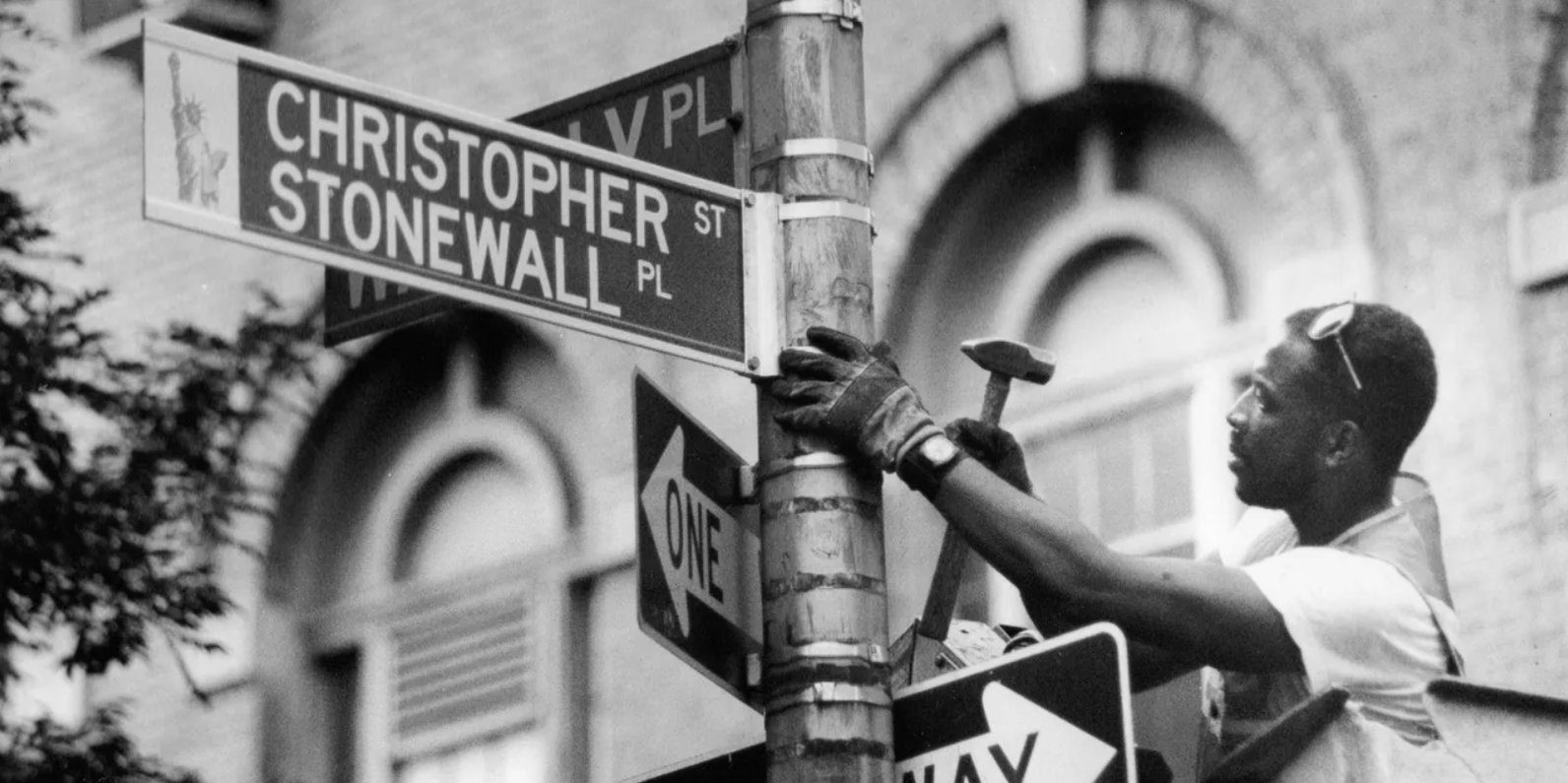
At this moment in our nation’s history, when LGBTQ+ Americans face erasure—whether through refusal of bodily autonomy and reproductive health care or censorship in classrooms and libraries—it’s never been more important to assert the simple fact of queer existence. Founded in August of 2015, the NYC LGBTQ Historic Sites Project has identified and contextualized hundreds of locations where queer people have made their mark since the founding of the city in the 17th century to the turn of the millennium. From the apartment building in which Ronald I. Jacobowitz lived when he founded Gay Men of the Bronx in 1990 to the Beach Haven Bar, which in the late 1970s was Staten Island’s only lesbian watering hole, the project proves queer people have always been a part of New York City.
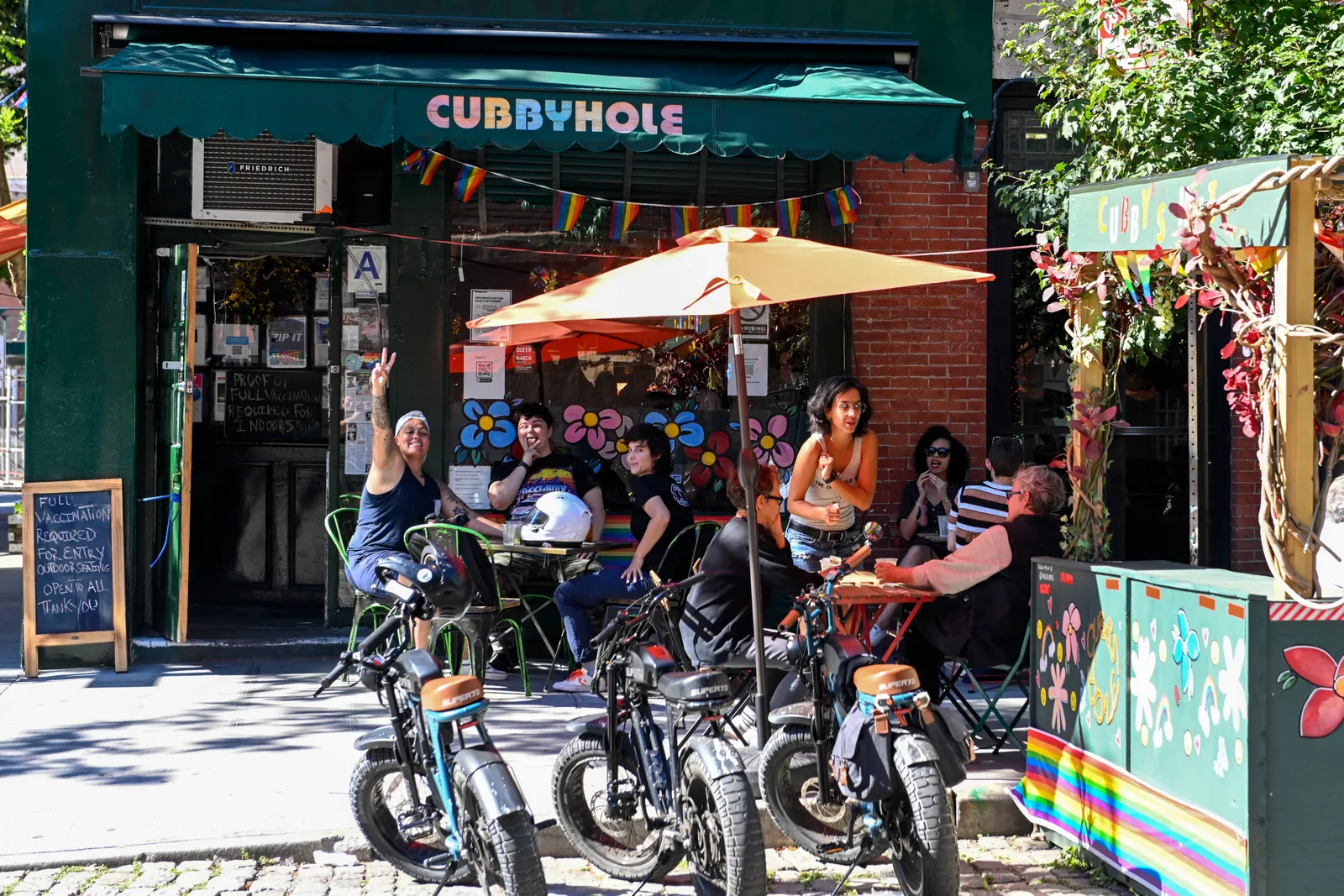
Plotted on an easily navigated website, the project pinpoints major landmarks like the West Side Tennis Club in Forest Hill Queens, host of the 1977 U.S. Open in which Renée Richards fought for and won the right to compete as the woman she was. It locates schools throughout the city named for LGBTQ+ heroes (including Langston Hughes and Lorraine Hansberry), and treasure troves like the Lesbian Herstory Archives in Park Slope, Brooklyn. And although Manhattan’s mainstream sites of cultural production, like almost every Broadway theater, have their moment in the spotlight, the list rightfully pays respect to the quarters that marginalized communities made for themselves, including Harlem’s cruisy Mt. Morris Baths and South Slope’s Transy House, the collective shelter and activist center Sylvia Rivera called home.
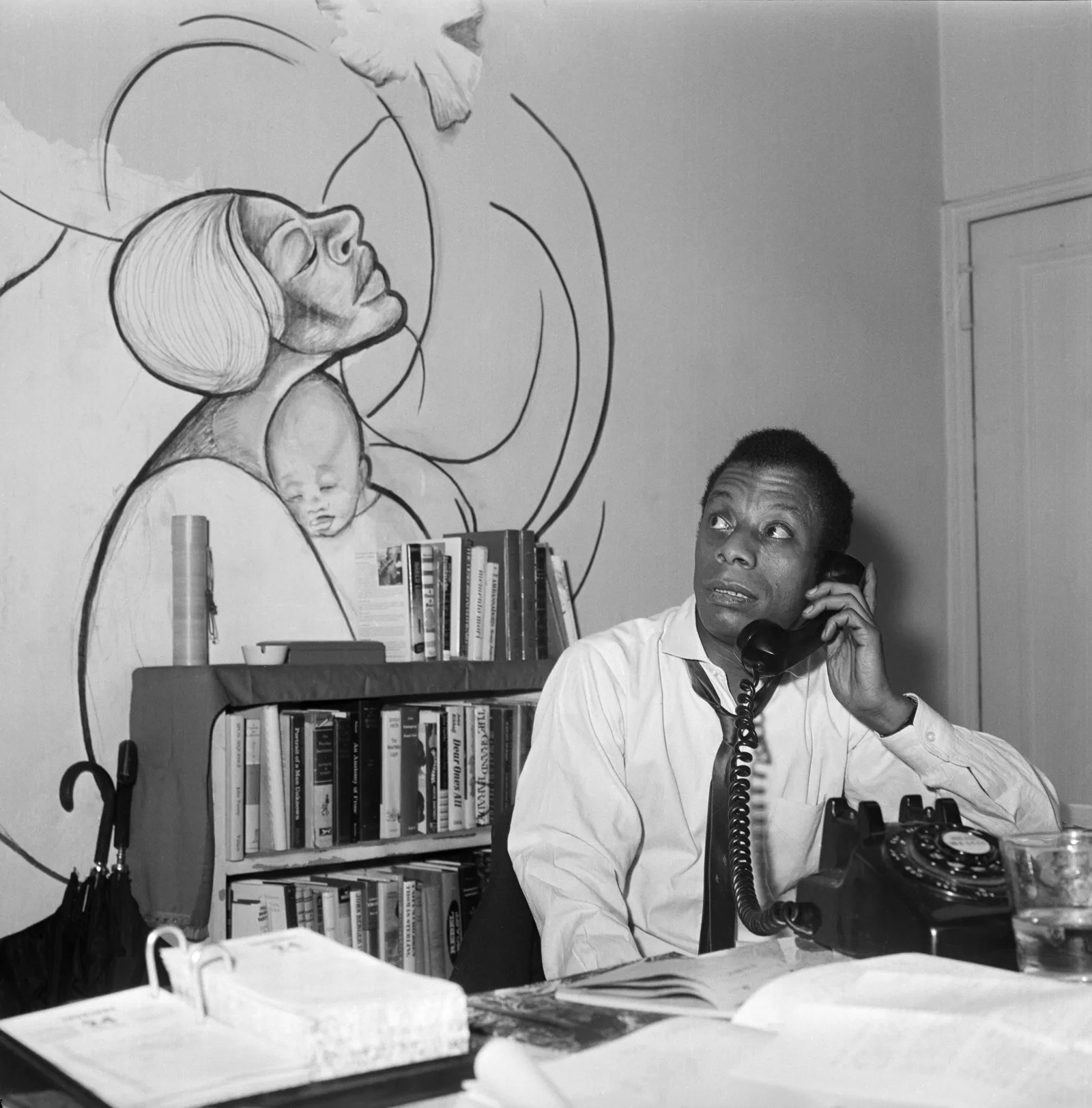
Such scope is by design, says Columbia University’s professor of historic preservation Andrew Scott Dolkart. He cofounded the project with consultant Ken Lustbader and Jay Shockley, senior historian at the NYC Landmarks Preservation Commission. “We want to make the point that LGBT history is American history. We want to make an invisible history visible,” Dolkart says. “So we’re looking at places where cultural events took place because we’re particularly interested in the impact that queer people have made on American culture.”
For historians like Hugh Ryan, author of When Brooklyn Was Queer and the new The Women’s House of Detention, the project’s focus allows the public to better understand the people within these historic spaces. “When you have a sense of the people who use a building—what the light felt like [to them], and the door they went through—it makes them human,” he says. “It is an experience that connects us emotionally, physically, directly to our ancestors. And those moments are important for marginalized histories where so little is preserved and passed down.”
After first meeting while in the Columbia Historic Preservation Program in 1994, Dolkart and his cohort helped celebrate the 25th anniversary of the Stonewall uprising by helping write the first guide to gay and lesbian sites in New York as members of the Organization of Lesbian and Gay Architects + Designers. Five years later they wrote the National Register of Historic Places nomination for the Stonewall bar and its surrounding area for its role in fostering the modern Gay Rights movement. “And then about five years ago,” Dolkart says, “the National Park Service was offering grants for underrepresented communities to expand the scope of listings on the National Register.” The trio applied and got the grant, which helped to birth the project itself.
Today, the NYC LGBTQ Historic Sites Project is part of the Partner Program of the Fund for the City of New York, a 501(c)(3) nonprofit, with foundational support from organizations including the J.M. Kaplan Fund and corporate sponsors like ConEd and American Express. It offers walking tours through gay enclaves like Greenwich Village, sites of queer excellence like the Met, and ancestral resting places like Brooklyn’s Green-Wood Cemetery. Since 2019, it has offered NYC public schools video segments and instructional materials on LGBTQ+ history throughout the boroughs.
The Women’s House of Detention: A Queer History of a Forgotten Prison
July 12, 2022 | 6:30PM - 7:30PM
Jefferson Market Library, New York Public Library
425 Avenue of the Americas
View on Google Maps
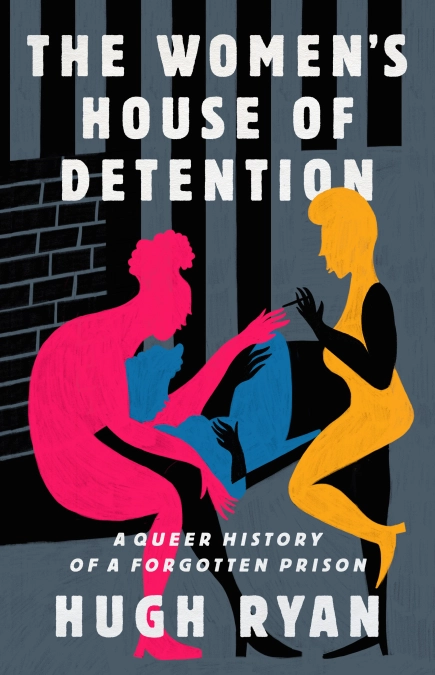 Join NYC LGBTQ Historic Sites project manager Amanda Davis at Jefferson Market Library on Thursday, July 14, part of a week of in-person festivities organized by the New York Public Library: The Jefferson Market Jubilee.
Amanda will appear with author Hugh Ryan for a discussion on the Women’s House of Detention, the former occupant of today’s Jefferson Market Garden and subject of Ryan’s latest book: The Women’s House of Detention: A Queer History of a Forgotten Prison.
Celebrate Pride: Stonewall & Greenwich Village LGBT History Tour
June 22, 2022 | 6PM
Arch in Washington Square Park
Washington Square Park
View on Google Maps
Pride is celebrated to commemorate the 1969 Stonewall uprising, a key turning point in the LGBT rights movement. In its immediate aftermath, new activist groups emerged fighting for liberation and visibility. However, New York City has a long and vibrant LGBT history dating to the early 20th century. Join Andrew Dolkart and Ken Lustbader, Co-Directors of the NYC LGBTQ Historic Sites Project, for an LGBT walking tour of Greenwich Village. Starting under the arch at Washington Square Park, learn about the LGBT presence in the Bohemian Village and hear about the places and people of the pre- and post-Stonewall LGBT civil rights movement and their lasting impact on American culture. The tour will also highlight the importance of these sites to a marginalized community that oftentimes had nowhere else to go to fully be themselves. Stops will include places connected to such groups as the Salsa Soul Sisters, Mattachine Society, and the Gay Liberation Front, and to the LGBT activists, artists, and business owners who found refuge in the Village since the late 19th century.
REGISTER HERE>
This is a FUNDRAISING tour; all money raised will support the ongoing work of the NYC LGBTQ Historic Sites Project.
Tour starts at the Arch in Washington Square Park, in Greenwich Village. Walking tour will take place rain or shine.
This event is presented with the support of the New York Community Trust and Con Edison.
Featured photo: Salsa Soul Sisters at the 1985 Gay Pride March. Photo by Suzanne Poli.
Celebrate Pride: Stonewall & Greenwich Village LGBT History Tour
June 14, 2022 | 6PM
Christopher Park / Stonewall National Monument
Christopher Street at West 4th Street
View on Google Maps
Pride is celebrated to commemorate the 1969 Stonewall uprising, a key turning point in the LGBT rights movement. In its immediate aftermath, new activist groups emerged fighting for liberation and visibility. However, New York City has a long and vibrant LGBT history dating to the early 20th century. Join Ken Lustbader and Jay Shockley, Co-Directors of the NYC LGBTQ Historic Sites Project, on a walking tour of pre- and post-Stonewall historic sites associated with early LGBT activism that influenced American culture and politics.
REGISTER HERE>
Starting at the Christopher Park, across from Stonewall, learn about the long-standing oppressive practices which led to the 1969 uprising and, before that, the 1966 “Sip-In” at Julius’ Bar. Stops along the tour will highlight such events as the formation of the first Pride march in 1970 and the birth of the STAR, the Street Transvestite Action Revolutionaries.
This is a FUNDRAISING tour; all money raised will support the ongoing work of the NYC LGBTQ Historic Sites Project.
Tour starts at the Stonewall National Monument at Christopher Park, across from the Stonewall Inn. Walking tour will take place rain or shine.
This event is presented with the support of the New York Community Trust and Con Edison.
Featured photo: Participants of the Stonewall uprising in front of the Stonewall bar, June 29, 1969. Gift of The Estate of Fred W. McDarrah.
Pride Month with the Met Museum: Richmond Barthé
June 29, 2022 | 12:30PM
We’re connecting the work of LGBTQ artists in the collection of The Metropolitan Museum of Art with the physical sites where they lived and worked this month in a five-part special Pride 2022 collaboration! Every week, we’ll join in conversation with our colleagues at the Met to celebrate the work and legacy of an artist who’s featured on our website, www.nyclgbtsites.org.
Watch along on Instagram: @nyclgbtsites and @metmuseum.
Weds 6/29 at 12PM *LIVE*
Richmond Barthé, whose sculptural work, “Green Pastures: The Walls of Jericho,” stands at Brooklyn’s Kingsborough Houses, along with smaller pieces in the Met Museum’s collection.
Learn more about the artist and work before the live talk: Richmond Barthé & “Green Pastures: The Walls of Jericho”.
Mark your calendar for the full schedule of talks.
Weds 6/1 at 11AM *LIVE*
Keith Haring, as discussed through his East Harlem mural, “Crack is Wack” and his 1983 “Untitled,” not normally on view!
Fri 6/10 at 12:30PM *LIVE*
Peter Hujar and David Wojnarowicz, focusing on the artists’ residences and studios at 181-189 Second Avenue, and “David Wojnarowicz with a Snake,” by Peter Hujar (1981), not normally on view!
Weds 6/15 at 10AM
Debut of the Project and the Met in conversation about the work of pioneering female photographer Berenice Abbott, who resided in Greenwich Village and whose portraiture and cityscapes are in the museum’s Drawings and Photographs collection.
Weds 6/22 at 12PM *LIVE*
Martin Wong, as discussed through his former Ridge Street residence as well as the Lower East Side handball court that is captured in his work within the Met Museum’s collection, “Attorney Street (Handball Court with Autobiographical Poem by Piñero)” (1982–84).
All of these virtual programs will be captioned for full accessibility and posted to Instagram subsequent to the live broadcast. We thank you in advance for your patience as we process and prepare these videos.
Pride Month with the Met Museum: Martin Wong
June 22, 2022 | 12PM
We’re connecting the work of LGBTQ artists in the collection of The Metropolitan Museum of Art with the physical sites where they lived and worked this month in a five-part special Pride 2022 collaboration! Every week, we’ll join in conversation with our colleagues at the Met to celebrate the work and legacy of an artist who’s featured on our website, www.nyclgbtsites.org.
Watch along on Instagram: @nyclgbtsites and @metmuseum.
Weds 6/22 at 12PM *LIVE*
Martin Wong, as discussed through his former Ridge Street residence as well as the Lower East Side handball court that is captured in his work within the Met Museum’s collection, “Attorney Street (Handball Court with Autobiographical Poem by Piñero)” (1982–84).
Learn more about the artist and work before the live talk: Martin Wong Residence & Studio.
Mark your calendar for the full schedule of talks.
Weds 6/1 at 11AM *LIVE*
Keith Haring, as discussed through his East Harlem mural, “Crack is Wack” and his 1983 “Untitled,” not normally on view!
Fri 6/10 at 12:30PM *LIVE*
Peter Hujar and David Wojnarowicz, focusing on the artists’ residences and studios at 181-189 Second Avenue, and “David Wojnarowicz with a Snake,” by Peter Hujar (1981), not normally on view!
Weds 6/15 at 10AM
Debut of the Project and the Met in conversation about the work of pioneering female photographer Berenice Abbott, who resided in Greenwich Village and whose portraiture and cityscapes are in the museum’s Drawings and Photographs collection.
Weds 6/29 at 12PM *LIVE*
Richmond Barthé, whose sculptural work, “Green Pastures: The Walls of Jericho,” stands at Brooklyn’s Kingsborough Houses, along with smaller pieces in the Met Museum’s collection.
All of these virtual programs will be captioned for full accessibility and posted to Instagram subsequent to the live broadcast. We thank you in advance for your patience as we process and prepare these videos.
Pride Month with the Met Museum: Berenice Abbott
June 15, 2022 | 10AM
We’re connecting the work of LGBTQ artists in the collection of The Metropolitan Museum of Art with the physical sites where they lived and worked this month in a five-part special Pride 2022 collaboration! Every week, we’ll join in conversation with our colleagues at the Met to celebrate the work and legacy of an artist who’s featured on our website, www.nyclgbtsites.org.
Watch along on Instagram: @nyclgbtsites and @metmuseum.
Weds 6/15 at 10AM
Debut of the Project and the Met in conversation about the work of pioneering female photographer Berenice Abbott, who resided in Greenwich Village and whose portraiture and cityscapes are in the museum’s Drawings and Photographs collection.
Learn more about the artist and work before the live talk: Berenice Abbott & Elizabeth McCausland Residence & Studio.
Mark your calendar for the full schedule of talks.
Weds 6/1 at 11AM *LIVE*
Keith Haring, as discussed through his East Harlem mural, “Crack is Wack” and his 1983 “Untitled,” not normally on view!
Fri 6/10 at 12:30PM *LIVE*
Peter Hujar and David Wojnarowicz, focusing on the artists’ residences and studios at 181-189 Second Avenue, and “David Wojnarowicz with a Snake,” by Peter Hujar (1981), not normally on view!
Weds 6/22 at 12PM *LIVE*
Martin Wong, as discussed through his former Ridge Street residence as well as the Lower East Side handball court that is captured in his work within the Met Museum’s collection, “Attorney Street (Handball Court with Autobiographical Poem by Piñero)” (1982–84).
Weds 6/29 at 12PM *LIVE*
Richmond Barthé, whose sculptural work, “Green Pastures: The Walls of Jericho,” stands at Brooklyn’s Kingsborough Houses, along with smaller pieces in the Met Museum’s collection.
All of these virtual programs will be captioned for full accessibility and posted to Instagram subsequent to the live broadcast. We thank you in advance for your patience as we process and prepare these videos.
Pride Month with the Met Museum: Peter Hujar and David Wojnarowicz
June 10, 2022 | 12:30PM
We’re connecting the work of LGBTQ artists in the collection of The Metropolitan Museum of Art with the physical sites where they lived and worked this month in a five-part special Pride 2022 collaboration! Every week, we’ll join in conversation with our colleagues at the Met to celebrate the work and legacy of an artist who’s featured on our website, www.nyclgbtsites.org.
Watch along on Instagram: @nyclgbtsites and @metmuseum.
Fri 6/10 at 12:30PM *LIVE*
Peter Hujar and David Wojnarowicz, focusing on the artists’ residences and studios at 181-189 Second Avenue, and “David Wojnarowicz with a Snake,” by Peter Hujar (1981), not normally on view!
Learn more about the artist and work before the live talk: Peter Hujar Residence & Studio / David Wojnarowicz Residence & Studio.
Mark your calendar for the full schedule of talks.
Weds 6/1 at 11AM *LIVE*
Keith Haring, as discussed through his East Harlem mural, “Crack is Wack” and his 1983 “Untitled,” not normally on view!
Weds 6/15 at 10AM
Debut of the Project and the Met in conversation about the work of pioneering female photographer Berenice Abbott, who resided in Greenwich Village and whose portraiture and cityscapes are in the museum’s Drawings and Photographs collection.
Weds 6/22 at 12PM *LIVE*
Martin Wong, as discussed through his former Ridge Street residence as well as the Lower East Side handball court that is captured in his work within the Met Museum’s collection, “Attorney Street (Handball Court with Autobiographical Poem by Piñero)” (1982–84).
Weds 6/29 at 12PM *LIVE*
Richmond Barthé, whose sculptural work, “Green Pastures: The Walls of Jericho,” stands at Brooklyn’s Kingsborough Houses, along with smaller pieces in the Met Museum’s collection.
All of these virtual programs will be captioned for full accessibility and posted to Instagram subsequent to the live broadcast. We thank you in advance for your patience as we process and prepare these videos.
Pride Month with the Met Museum: Keith Haring
June 1, 2022 | 11AM
We’re connecting the work of LGBTQ artists in the collection of The Metropolitan Museum of Art with the physical sites where they lived and worked this month in a five-part special Pride 2022 collaboration! Every week, we’ll join in conversation with our colleagues at the Met to celebrate the work and legacy of an artist who’s featured on our website, www.nyclgbtsites.org.
Watch along on Instagram: @nyclgbtsites and @metmuseum.
Weds 6/1 at 11AM *LIVE*
Keith Haring, as discussed through his East Harlem mural, “Crack is Wack” and his 1983 “Untitled,” not normally on view!
Learn more about the artist and work before the live talk: Keith Haring & “Crack is Wack” Playground.
Mark your calendar for the full schedule of talks.
Fri 6/10 at 12:30PM *LIVE*
Peter Hujar and David Wojnarowicz, focusing on the artists’ residences and studios at 181-189 Second Avenue, and “David Wojnarowicz with a Snake,” by Peter Hujar (1981), not normally on view!
Weds 6/15 at 10AM
Debut of the Project and the Met in conversation about the work of pioneering female photographer Berenice Abbott, who resided in Greenwich Village and whose portraiture and cityscapes are in the museum’s Drawings and Photographs collection.
Weds 6/22 at 12PM *LIVE*
Martin Wong, as discussed through his former Ridge Street residence as well as the Lower East Side handball court that is captured in his work within the Met Museum’s collection, “Attorney Street (Handball Court with Autobiographical Poem by Piñero)” (1982–84).
Weds 6/29 at 12PM *LIVE*
Richmond Barthé, whose sculptural work, “Green Pastures: The Walls of Jericho,” stands at Brooklyn’s Kingsborough Houses, along with smaller pieces in the Met Museum’s collection.
All of these virtual programs will be captioned for full accessibility and posted to Instagram subsequent to the live broadcast. We thank you in advance for your patience as we process and prepare these videos.
Remembering a ‘Sip-In’ for Gay Rights 56 Years Later
April 22, 2022
By: Leah Foreman
A permanent plaque at Julius’ Bar to commemorate the fight against discrimination
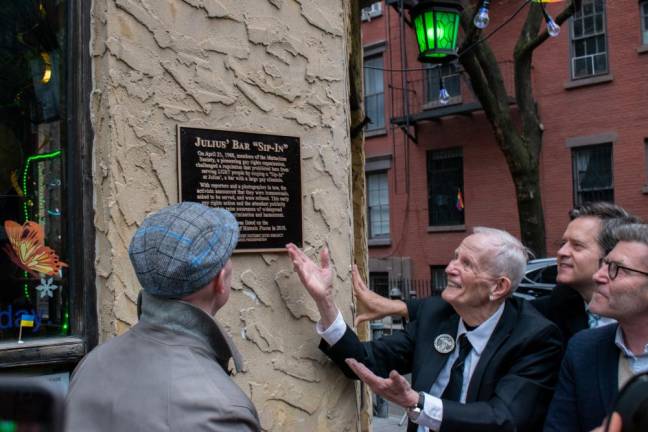
Fifty-six years ago, at Julius’ Bar in Greenwich Village, four openly gay men held a “Sip-In.”
The men were Dick Leitsch, Craig Rodwell, John Timmons and Randy Wicker and they were part of an early gay rights group known as the Mattachine Society. Leitsch and Rodwell were the New York chapter of the Mattachine Society’s president and vice president respectively.
On April 21, 1966, they traveled to various city bars with reporters to document the discrimination they faced under the New York State Liquor Authority, which prevented suspected gay or lesbian people from being served alcohol. After arriving at Julius’, they told the bartender they were homosexuals and he put his hand over a glass in front of them, denying them service.
This moment was captured in a photograph for the Village Voice by the late photographer Fred W. McDarrah. This resulted in unprecedented coverage of LGBTQ activism and civil rights.
The event later led to a change in NYSLA policy.
Today, this history is often overlooked. And Randy Wicker is the only surviving member of the Mattachine’s “Sip-In” left to tell the tale.
“When we took this action, we were legally challenging the state laws that said it was illegal to serve homosexuals alcohol or shall allow them to gather on your premises – that’s right of assembly,” Wicker said. “And by taking that legal action, setting that house of cards in order, we cracked the chain that held the Village and held the gay community in this country locked in the hands of the criminal underground.”
“Make Invisible History Visible”
More than 50 years later to the day, people gathered on West 10th Street to celebrate the bar and its history as a permanent plaque was installed to enshrine its contribution to gay civil rights. Julius’ is also the city’s oldest gay bar.
“Today we make an invisible history visible by installing a commemorative plaque on the exterior of Julius’ Bar, an important location in LGBTQ history,” Ken Lustbader, a founder of NYC LGBTQ Historic Sites Project, said to the crowd.
When NYC LGBTQ Historic Sites Project was organized in 2015 to protect historically significant sites, Julius’ was the site on the list, which entered the National Register of Historic Places in 2016. Julius’ became the second LGBTQ site in the country on the register, after The Stonewall Inn, which got on in 1999.
The Greenwich Village Society for Historical Preservation worked in concert with NYC LGBTQ Historic Sites Project to get Julius’ recognized.
“What we’re doing is we’re helping people understand that the process of getting to where we were today was a long and slow one that took a lot of bravery, a lot of perseverance, and a lot of forward thinking by a lot of people —not all of whom are that well remembered today, but they should be,” said Andrew Berman, the executive director of GVSHP.
Plea for Donations
The plaque unveiling was held on the 56th Anniversary of the “Sip-In” and the six-year anniversary of when Julius’ got on the historic registry. It was pushed back because of the bar’s previous financial trouble and to ensure people could celebrate in person.
From shutting down the bar completely before St. Patrick’s Day in 2020 to serving to-go burgers only to limited indoor seating to surviving the brunt of the pandemic, Julius’ has been through the ringer. The bar’s owner, Helen Buford, made a plea for donations.
She received donations from patrons and from the Gil Foundation, a pro-LGBTQ philanthropic organization, which donated $20,000 and pledged to match donations on a GoFundMe created for the bar up to $25,000.
Broadway star and multihyphenate talent John Cameron Mitchell was born three years to the day before the “Sip-In.”
“This place is not going to become a Starbucks,” Mitchell said on April 21 in front of Julius’.
Except for during COVID, Mitchell and his friends have held dance parties at Julius’ once a month.
State Senator Brad Hoylman presented Buford with a certificate honoring Julius’ designation as a historic business in New York.
“I see this as kind of a collective F.U. to Florida and Texas as we stand here,” Hoylman said. “Because we are not going to let queer history be erased.”
Randy Wicker got up to the podium and spoke after being cajoled by the eager audience.
“So there are two reasons that Julius’ [is] my favorite bar. First of all, it’s because it was the place where we started the ball rolling to liberate our society from the mob. The second is a little bit more personal,” Wicker said as he pulled out a New York Times clipping, encased in plastic. “I got my picture two times on the obituary page of the New York Times. And I’m still here at 84 years old, to tell you about it … and say I’m still here, I’m still fighting. I’m the last Mattichino and will stay active as long as I can.”
I see this as kind of a collective F.U. to Florida and Texas as we stand here. Because we are not going to let queer history be erased. —State Senator Brad Hoylman
Photos: John Cameron Mitchell & More Acknowledge Julius’ Significance to LGBT Activism & History
April 22, 2022
By: Chloe Rabinowitz
Activists, preservationists, historians and others gathered to honor the site of the 1966 “Sip-In” at Julius’, on 56th anniversary of event.
Yesterday, Village Preservation; the NYC LGBTQ Historic Sites Project; the owner of Julius’ Bar, located at 159 West 10th Street; special guest, Broadway star John Cameron Mitchell; LGBT activist and 1966 “Sip-In” participant, Randy Wicker; and others gathered for the unveiling of a plaque to acknowledge Julius’ significance to LGBT activism and history.
Check out photos below!
On April 21, 1966, members of the Mattachine Society, an early gay rights group, organized what became known as the “Sip-In” to challenge New York State Liquor Authority (SLA) regulations that were promulgated so that bars could not serve drinks to known or suspected gay men or lesbians, since their presence was considered de facto disorderly. The SLA regulations were one of the primary governmental mechanisms of oppression against the gay community because they precluded the right to free assembly. This was particularly important because bars were one of the few places where gay people could meet each other.
Mattachine members Dick Leitsch, Craig Rodwell, and John Timmons, accompanied by several reporters, went to a number of bars to document this discrimination. At Julius’, where they were joined by Randy Wicker, the group announced that they were “homosexuals” and asked to be served a drink – the bartender refused their request. This refusal received publicity in The New York Times and the Village Voice and was the first time LGBTQ discrimination had been proactively documented in mainstream media. The reaction by the SLA and the newly-empowered New York City Commission on Human Rights resulted in a change in policy and the birth of a more open gay bar culture. Scholars of gay history consider the “Sip-In” at Julius’ a key event leading to the growth of legitimate gay bars and the development of the bar as the central social space for urban gay men and lesbians.
Ken Lustbader, NYC LGBTQ Historic Sites Project: “Today we make an invisible history visible by installing a commemorative plaque on the exterior of Julius’ bar, an important location in LGBTQ history. In April 1966, courageous activists staged a ‘Sip-In’ to publicize the homophobic discrimination that the LGBTQ community experienced in bars, which could refuse them service if suspected of being homosexual. These pre-Stonewall trailblazers challenged the idea that LGBTQ people were second-class citizens – they deserved safe and welcoming places to socialize and build community. The NYC LGBTQ Historic Sites Project is proud to have undertaken extensive research and writing when nominating Julius’ to the State and National Registers of Historic Places in 2016 for LGBTQ history. Since then, we have nominated an additional ten sites directly associated with LGBTQ history. With the recent pushback of LGBTQ rights and attacks on queer people throughout the country, we’re proud to join with our partners at Village Preservation and Helen Buford, owner of Julius’, to formally memorialize this history with this tangible plaque. It will provide intangible benefits of identity, pride, and a connection to the past.”
Andrew Berman, Village Preservation: “As the city’s oldest gay bar and home of the pioneering 1966 ‘Sip-In’ protesting anti-gay discrimination, we are proud to be placing a plaque at Julius’ with our partners at the NYC LGBTQ Historic Sites Project to honor this uniquely important civil rights site. Three years before Stonewall, when being gay was still considered a crime, these brave individuals protested for their right to gather free from harassment and discrimination. This is part of a long tradition of pioneering efforts for civil rights for LGBTQ people, African Americans, women, immigrants, and many others rooted in this neighborhood, from the first free black settlement in North America located here in the 17th century, to the fight for Women’s suffrage here in the late 19th and early 20th centuries, to the Stonewall Rebellion and many other agitations for LGBTQ+ rights which took place here in the late 20th century. We’re thrilled to be able to add this site as our 19th historic plaque in our neighborhoods, which have marked the homes of figures from James Baldwin to Jane Jacobs, Lorraine Hansberry to LeRoi Jones, Anais Nin to Alex Haley. We’re especially proud given that in 2012 we were able to get Julius’ determined eligible for the State and National Registers of Historic Places, when few LGBTQ+ sites had ever received such a determination, and we continue to advocate for individual New York City landmark designation for the site.”
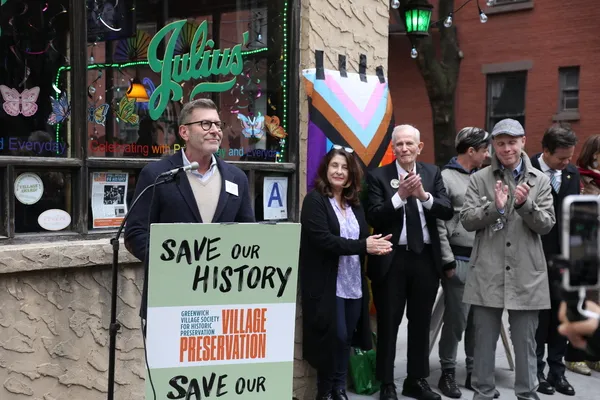
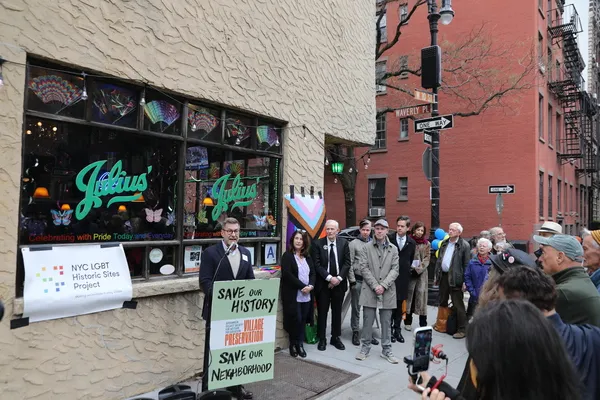
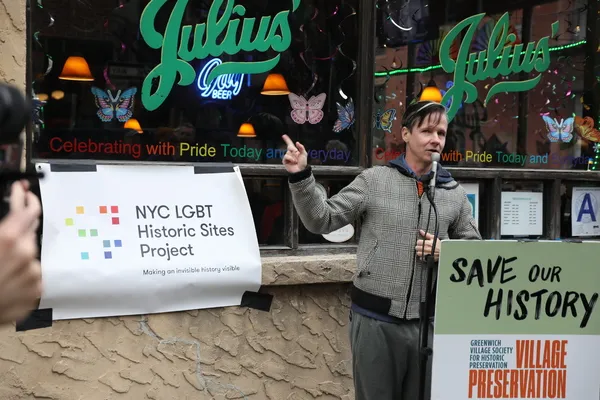
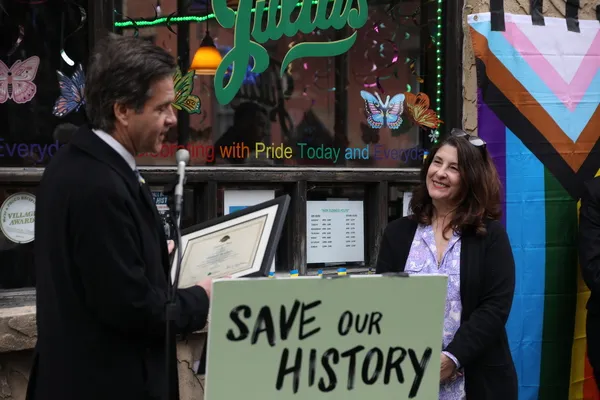
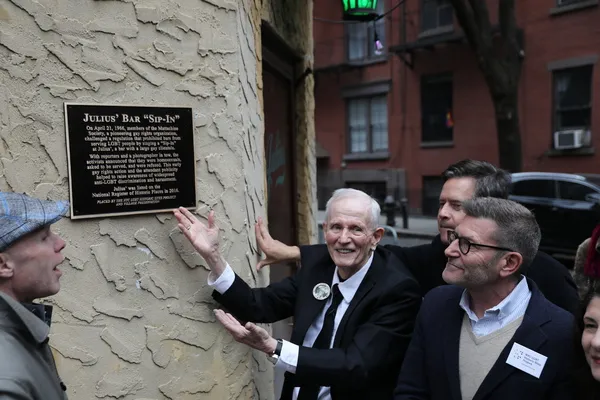
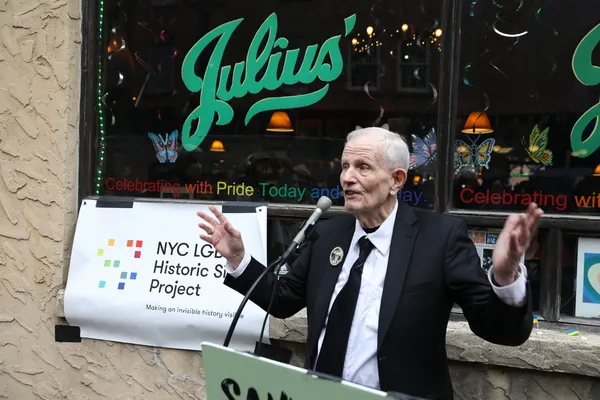
NYC’s oldest gay bar honored with historic plaque
April 25, 2022
By: Aaron Ginsburg
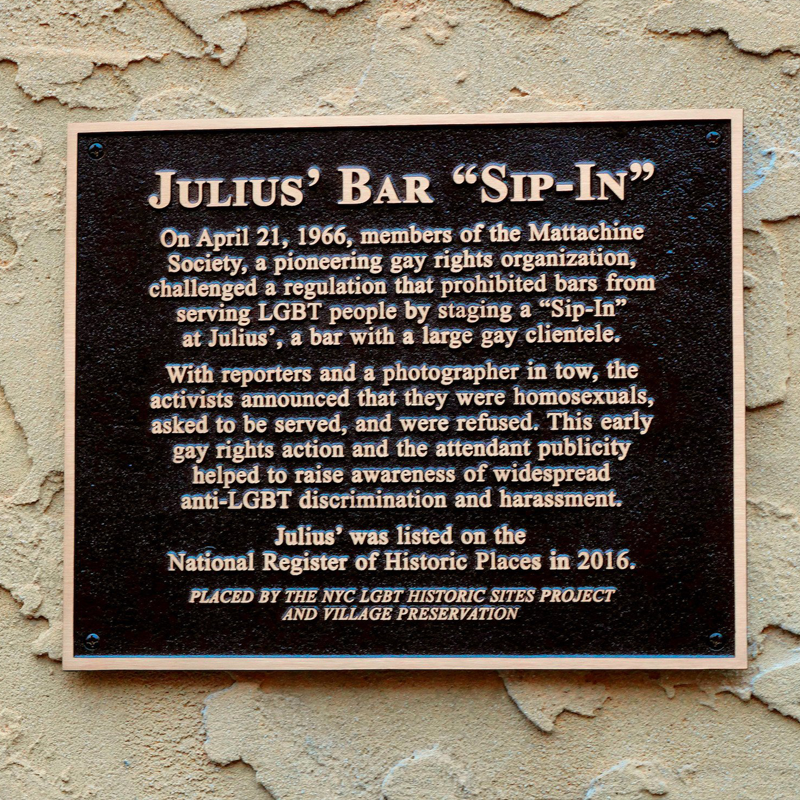
The site of a monumental event in the LGBTQ community’s fight against anti-gay discrimination was honored last week with a historic plaque. The Village Preservation on Thursday unveiled the plaque at 159 West 10th Street, also known as Julius’ Bar. The bar was the site of the first “Sip-In,” an act of defiance in which members of gay rights groups entered the bar and asked to be served drinks while announcing they were homosexuals, going against the discriminatory regulations of the New York State Liquor Authority (SLA) which at the time prohibited bars from serving gays or lesbians.
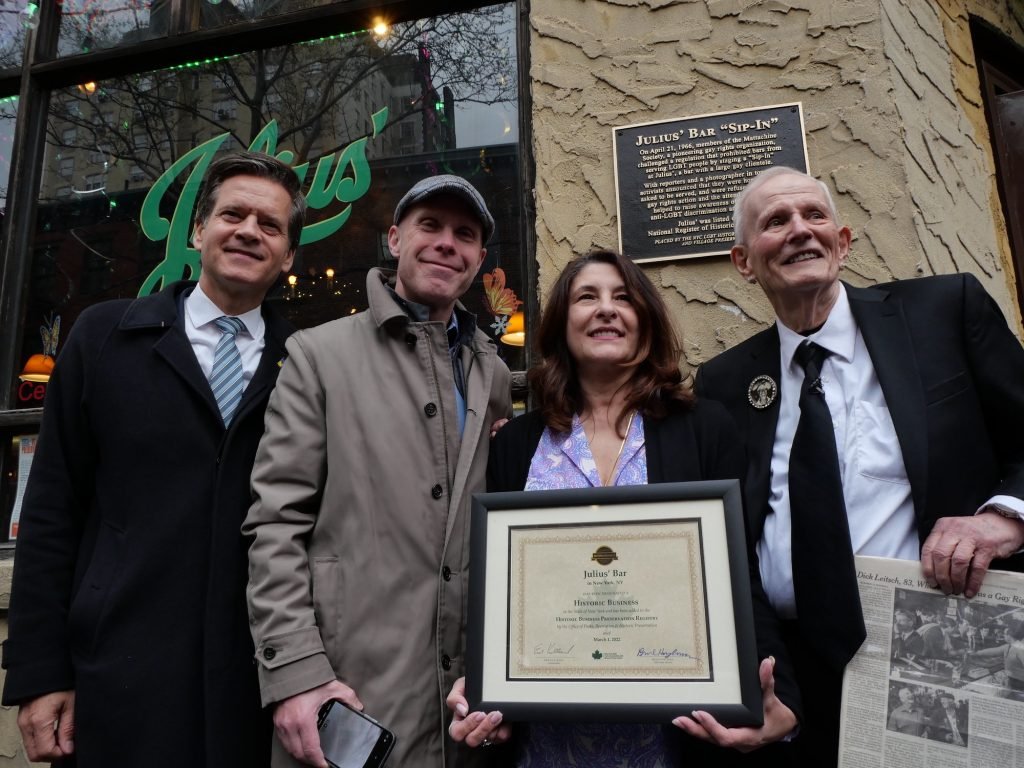
The Village Preservation was joined by the NYC LGBTQ Historic Sites Project, Broadway star John Cameron Mitchell, and LGBTQ activist and “Sip-In” participant Randy Wicker.
Taking place on April 21, 1966, the first “Sip-In” was led by members of the Mattachine Society, a gay rights group. Members of Mattachine entered a multitude of bars accompanied by reporters to document the discrimination they would face. The members entered Julius’ Bar where they were joined by Wicker and asked the bartender to serve them drinks while announcing they were homosexuals, after which the bartender refused.
The bartender’s refusal was covered in the New York Times and the Village Voice, one of the first times LGBTQ discrimination received significant coverage in the mainstream media. This event led to historic changes in policy and is considered by historians to be a key moment in the creation of legitimate gay bars, an important social space for gay men and lesbians.
“As the city’s oldest gay bar and home of the pioneering 1966 ‘Sip-In’ protesting anti-gay discrimination, we are proud to be placing a plaque at Julius’ with our partners at the NYC LGBTQ Historic Sites Project to honor this uniquely important civil rights site,” Andrew Berman, Executive Director of Village Preservation, said.
“Three years before Stonewall, when being gay was still considered a crime, these brave individuals protested for their right to gather free from harassment and discrimination.”
The plaque reads: “On April 21, 1966, members of the Mattachine Society, a pioneering gay rights organization, challenged a regulation that prohibited bars from serving LGBT people by staging a “Sip-In” at Julius’, a bar with a large gay clientele.”
The plaque continues: “With reporters and a photographer in tow, the activists announced they were homosexuals, asked to be served, and were refused. This early gay rights action and the attendant publicity helped to raise awareness of widespread anti-LGBT discrimination and harassment.”
This plaque marks the 19th location commemorated by the Village Preservation, which has honored a number of historic homes and establishments in the area. The last unveiling covered by 6sqft was of urbanist Jane Jacob’s Greenwich Village home where she wrote her seminal work, The Death and Life of American Cities.
PHOTOS: Plaque Unveiled at Julius’ Bar, Commemorating History-Making Act of Civil Disobedience
April 22, 2022
FOR IMMEDIATE RELEASE
PHOTOS: Plaque Unveiled at Julius’ Bar, Commemorating History-Making Act of Civil Disobedience
Activists, preservationists, historians and others gather to honor the site of the 1966 “Sip-In” at Julius’, on 56th anniversary of event
NEW YORK, NY —On April 21, 2022, Village Preservation, the NYC LGBTQ Historic Sites Project, the owner of Julius’ Bar, Broadway star John Cameron Mitchell, LGBT activist and 1966 “Sip-In” participant, Randy Wicker, and others, gathered for the unveiling of a plaque to acknowledge Julius’ significance to LGBT activism and history.
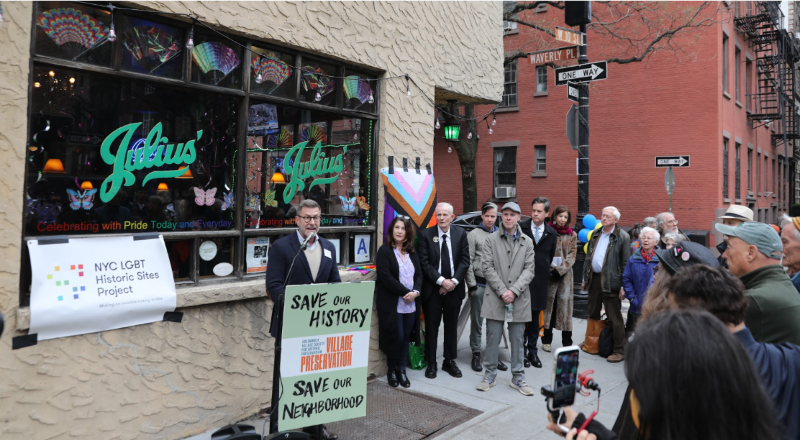
On April 21, 1966, members of the Mattachine Society, an early gay rights group, organized what became known as the “Sip-In” to challenge New York State Liquor Authority (SLA) regulations that were promulgated so that bars could not serve drinks to known or suspected gay men or lesbians, since their presence was considered de facto disorderly. The SLA regulations were one of the primary governmental mechanisms of oppression against the gay community because they precluded the right to free assembly. This was particularly important because bars were one of the few places where gay people could meet each other.
Mattachine members Dick Leitsch, Craig Rodwell, and John Timmons, accompanied by several reporters, went to a number of bars to document this discrimination. At Julius’, where they were joined by Randy Wicker, the group announced that they were “homosexuals” and asked to be served a drink — the bartender refused their request. This refusal received publicity in The New York Times and the Village Voice and was the first time LGBTQ discrimination had been proactively documented in mainstream media. The reaction by the SLA and the newly-empowered New York City Commission on Human Rights resulted in a change in policy and the birth of a more open gay bar culture. Scholars of gay history consider the “Sip-In” at Julius’ a key event leading to the growth of legitimate gay bars and the development of the bar as the central social space for urban gay men and lesbians.
Ken Lustbader, NYC LGBTQ Historic Sites Project: “Today we make an invisible history visible by installing a commemorative plaque on the exterior of Julius’ bar, an important location in LGBTQ history. In April 1966, courageous activists staged a ‘Sip-In’ to publicize the homophobic discrimination that the LGBTQ community experienced in bars, which could refuse them service if suspected of being homosexual. These pre-Stonewall trailblazers challenged the idea that LGBTQ people were second-class citizens — they deserved safe and welcoming places to socialize and build community. The NYC LGBTQ Historic Sites Project is proud to have undertaken extensive research and writing when nominating Julius’ to the State and National Registers of Historic Places in 2016 for LGBTQ history. Since then, we have nominated an additional ten sites directly associated with LGBTQ history. With the recent pushback of LGBTQ rights and attacks on queer people throughout the country, we’re proud to join with our partners at Village Preservation and Helen Buford, owner of Julius’, to formally memorialize this history with this tangible plaque. It will provide intangible benefits of identity, pride, and a connection to the past.”
Andrew Berman, Village Preservation: “As the city’s oldest gay bar and home of the pioneering 1966 ‘Sip-In’ protesting anti-gay discrimination, we are proud to be placing a plaque at Julius’ with our partners at the NYC LGBTQ Historic Sites Project to honor this uniquely important civil rights site. Three years before Stonewall, when being gay was still considered a crime, these brave individuals protested for their right to gather free from harassment and discrimination. This is part of a long tradition of pioneering efforts for civil rights for LGBTQ people, African Americans, women, immigrants, and many others rooted in this neighborhood, from the first free black settlement in North America located here in the 17th century, to the fight for Women’s suffrage here in the late 19th and early 20th centuries, to the Stonewall Rebellion and many other agitations for LGBTQ+ rights which took place here in the late 20th century. We’re thrilled to be able to add this site as our 19th historic plaque in our neighborhoods, which have marked the homes of figures from James Baldwin to Jane Jacobs, Lorraine Hansberry to LeRoi Jones, Anais Nin to Alex Haley. We’re especially proud given that in 2012 we were able to get Julius’ determined eligible for the State and National Registers of Historic Places, when few LGBTQ+ sites had ever received such a determination, and we continue to advocate for individual New York City landmark designation for the site.”
About the NYC LGBTQ Historic Sites Project
The award-winning NYC LGBTQ Historic Sites Project, launched in 2015, is the culmination of over 30 years of research and advocacy by its founders, who are national pioneers in the historic preservation of LGBT sites. Their initial efforts to nominate the Stonewall Inn to the National Register of Historic Places in 1994 came to fruition five years later, and further efforts secured the designation of Stonewall National Monument in 2016. The NYC LGBTQ Historic Sites Project has since nominated eleven more LGBT sites to the National Register, from James Baldwin’s residence on the Upper West Side to the Women’s Liberation Center in Chelsea. In addition, six LGBT sites that the Project recommended to the NYC Landmarks Preservation Commission, including the Audre Lorde Residence on Staten Island and the Gay Activists Alliance Firehouse in Soho, became city landmarks in 2019. The Project also highlights the city’s LGBT history beyond Greenwich Village with a website of nearly 400 diverse places in all five boroughs. Dating to the 17th century, these sites illustrate the community’s influence on NYC and American history and culture.
The Project further disseminates its work by providing walking tours (also accessible through a free app), presenting lectures, engaging the community through events, developing educational programs for New York City public school students, and sharing its content through robust social media channels. Its goal is to make an invisible history visible while fostering pride and awareness for LGBT people around the world.
About Village Preservation
Since 1980 Village Preservation (VP) has documented, celebrated, and fought to preserve the special architectural and cultural heritage of Greenwich Village, the East Village, and NoHo, successfully advocating for landmark designation of over 1,500 buildings, and zoning protections for nearly 100 blocks. VP places a special emphasis on civil rights and social justice history connected to our neighborhoods; in 1999 it was co-applicant for listing Stonewall on the State and National Register of Historic Places — the first time any LGBTQ+ site had ever been so honored in the country — and in 2015 successfully helped lead the campaign for individual NYC landmark designation of the site. VP has also successfully proposed and secured landmark designation of the former NAACP headquarters, the LGBT Community Center, the Gay Activists Alliance Firehouse, and the studio of Jean-Michel Basquiat, among other sites.
Village Preservation offers 80 public programs annually about our neighborhoods’ histories; a need-blind children’s education program focused on architecture, African American history, and immigrant history; dozens of online maps and tours, including our Civil Rights and Social Justice Map, with over 150,000 views; a 4,000 piece historic image archive; and a collection of over 60 oral histories with important figures in the civil rights, social justice, artistic, literary, business, and cultural history of our neighborhoods.
Web: www.nyclgbtsites.org & www.villagepreservation.org
Instagram: @nyclgbtsites & @gvshp_nyc
Twitter: @nyclgbtsites & @gvshp
Facebook: /nyclgbtsites & /villagepreservation
###
NYC’s oldest gay bar — home to major pre-Stonewall public action for LGBTQ rights — gets commemorative plaque
April 20, 2022
By: Muri Assunção
Julius’ Bar, New York City’s oldest continuously operating gay bar, and home to a pivotal pre-Stonewall public action for LGBTQ rights, is finally getting a commemorative plaque — 56 years after a group of gay men used their drink orders to fight back against bars that refused to serve members of the LGBTQ community.
The plaque, presented by the NYC LGBTQ Historic Sites Project in collaboration with Village Preservation, will honor Julius’ role in the ongoing fight for queer rights, as well as the site of the protest known as “Sip-In.”
On April 21, 1966, four members of the Mattachine Society, an early queer rights organization decided to challenge regulations adopted by bars to deny service to patrons who were seen as “disorderly” — a vague definition that New York City police used to refer to same-sex flirting, kissing or even touching.
Inspired by earlier sit-in demonstrations, protests enacted to desegregate diners in the American south, the four activists set out to expose the bigotry faced by the community at the time — three years before the Stonewall Riots, a series of violent protests often seen as the catalyst for a new phase in the fight for LGBTQ rights.
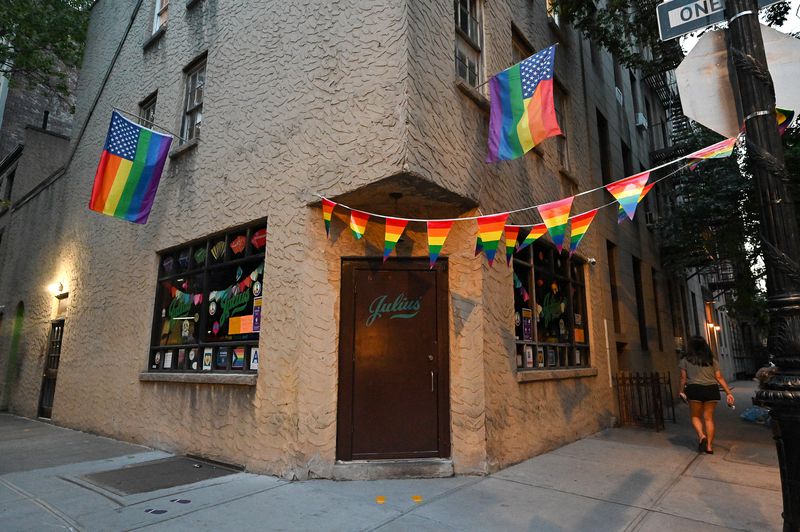
They invited some reporters and a photographer, ordered a drink at Julius’ and then declared that they were gay. The bartender refused to serve them, the story made it to the press, and their courageous action became instrumental in bringing attention to widespread anti-LGBTQ discrimination.
That pivotal moment in queer liberation history, known as the “Sip-In” at Julius’, is the first documented case of anti-LGBTQ discrimination in New York City, according to Ken Lustbader, Ken Lustbader, a historic preservation consultant and a co-founder of the NYC LGBT Historic Sites Project.
On Thursday, to mark Sip-In’s 56th anniversary, and to honor the listing of Julius’ Bar on the National Register of Historic Places, the organization, in collaboration with Village Preservation, is hosting an event to honor the bar — and the historic event.
Lustbader, Village Preservation’s Andrew Berman, as well as award-winning actor, screenwriter and director John Cameron Mitchell (“Hedwig and the Angry Inch”), will unveil a historic plaque to celebrate the bar’s legacy on Thursday at 6 p.m. ET at Julius’ Bar, at 159 West 10th Street.
They will be joined by Julius’ owner Helen Buford, as well as Randy Wicker, the last living participant of the protest.
“This is about visibility,” Lustbader told the Daily News, speaking of the importance of having a plaque on a building for people to “walk by and see where gay history took place.”
“It’s especially important now with the pushback of [LGBTQ] rights and visibility, and its impact on children to know that there were other people that fought and who were visible and understood what they went through.”
He added, “We’re hoping that future generations, including this generation, will understand the importance of visibility and being who you are, and paving the way for a person to feel whole and entitled to be who they are.”
Gay Greenwich Village (Instagram Live tour)
May 6, 2022 | 11:00AM - 12:00PM
Greenwich Village
 LED BY ANDREW DOLKART, NYC LGBT HISTORIC SITES PROJECT CO-DIRECTOR
Join our co-director Andrew Dolkart for a virtual walk, in-the-field, discussing LGBT historic sites in Greenwich Village for Municipal Arts Society‘s 2022 Janes Walk events. Our 20-minute Instagram Live tour will center on Washington Square Park, itself the site of rallies and gatherings and, around it, former residences of notable individuals. Learn about the LGBT presence in the Bohemian Village and hear about the places and people of the pre- and post-Stonewall LGBT civil rights movement and their lasting impact on American culture.
ACCESSIBILITY
This walk will be virtual, hosted on Instagram Stories Live, and we will activate close captioning as well as monitor chat with questions and those in need of assistance.
Click here to follow @NYCLGBTSites on Instagram so you can follow along live on May 6.
Gay Green-Wood Trolley Tour
May 15, 2022 | 1:00PM-3:00PM
Green-Wood Cemetery
500 25th St, Brooklyn, NY 11232
View on Google Maps
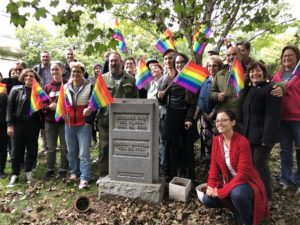 The Project joins Green-Wood Cemetery to celebrate the illuminating LGBTQ+ permanent residents who have made a lasting impact on American history and culture. Along the way you will visit the graves of “It’s Raining Men” co-writer, Paul Jabara; sculptor of the Angel of the Waters sculpture atop Central Park’s Bethesda Fountain, Emma Stebbins; and activists and founders of the Hetrick Martin Institute, Drs. Emery Hetrick and Damien Martin, among others.
This trolley tour is led by Andrew Dolkart, Co-Director of the NYC LGBTQ Historic Sites Project, and Neela Wickremesinghe, the Robert A. and Elizabeth Rohn Jeffe Director of Restoration and Preservation at Green-Wood.
Price: $30, and $25 for Green-Wood members
Silent Partners — Exploring Woodlawn’s LGBTQ History
May 1, 2022 | 12:00PM
Woodlawn Cemetery
Woodlawn Cemetery, Jerome Avenue Entrance
View on Google Maps
Join us to plant rainbow flags at the Woodlawn Cemetery graves of vaudeville stars, suffragists, Harlem Renaissance figures, artists, writers and other LGBT individuals who are buried at the cemetery. The tour will be led by project co-directors, including Columbia University professor Andrew Dolkart and former Landmarks Commission historian Jay Shockley.
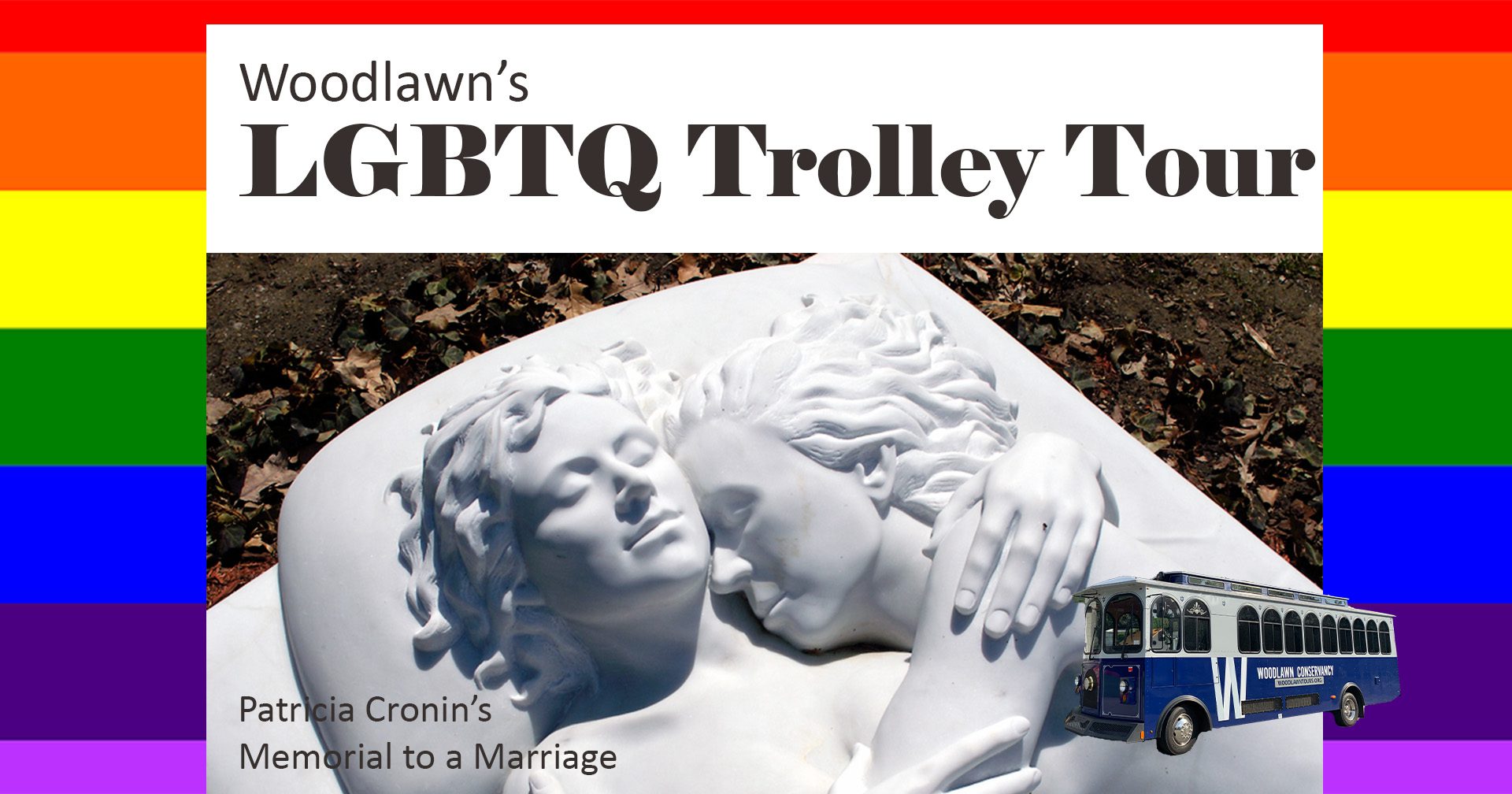
Plaque Unveiling: Julius’ Bar
April 21, 2022 | 6:00PM-7:15PM
Julius's Bar
159 West 10th Street
View on Google Maps
Join the NYC LGBTQ Historic Sites Project, in collaboration with Village Preservation, at the unveiling of a plaque at Julius’ that honors the bar’s listing on the National Register of Historic Places. The event will take place on Thursday, April 21, at 6:00 p.m., which falls on the 56th anniversary of the “Sip-In” at Julius’.
On April 21, 1966, members of the Mattachine Society, a pioneering gay rights organization, challenged a regulation that prohibited bars from serving LGBT people by staging a “Sip-In” at Julius’, a bar with a large gay clientele.
With reporters and a photographer in tow, the activists announced that they were homosexuals, asked to be served, and were refused. This early gay rights action and the attendant publicity helped to raise awareness of widespread anti-LGBT discrimination and harassment.
Julius’ was listed on the National Register of Historic Places by the NYC LGBTQ Historic Sites Project in 2016.
The event will begin promptly at 6:00 p.m. on April 21st and take place outdoors, rain or shine.
Julius’ is located at 159 West 10th Street at Waverly Place in Manhattan.
Registration required.
Click to register.
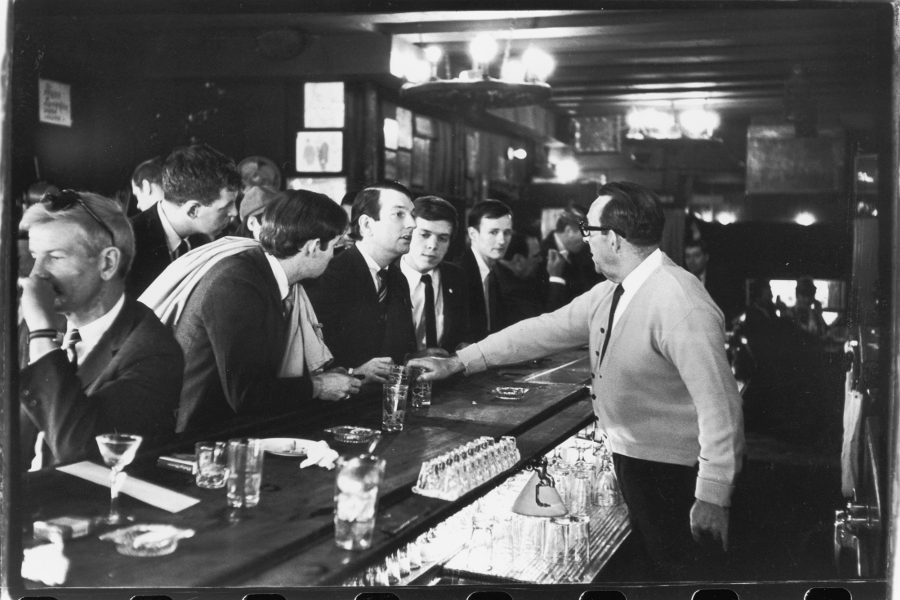
A Little “Site” Music: LGBT Composers, Musicians & Singers in New York City
February 3, 2022 | 6:30PM
In celebration of the LGBT community’s impact on music and in tribute to the late Stephen Sondheim, Project manager Amanda Davis will take you on a tour of LGBT historic sites connected to music in New York City. A sampling includes the residences of jazz and blues artists in Harlem, venues as grand as Lincoln Center and as intimate as a Greenwich Village coffeehouse, and other places associated with a wide range of tunes, such as classical, cabaret, folk, and popular music.
Click to register.
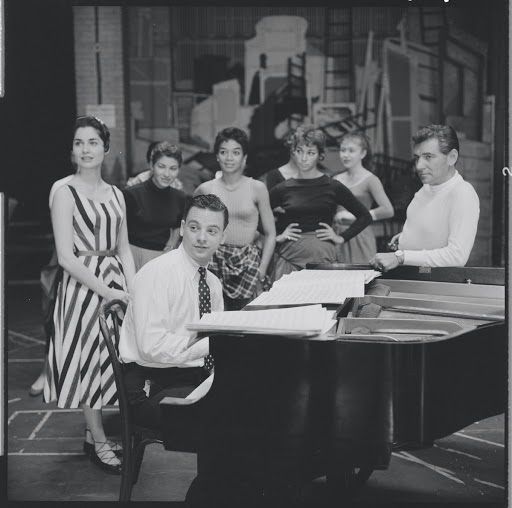
Photo: Stephen Sondheim (seated at piano) and Leonard Bernstein (standing far right) with the cast of West Side Story at the Winter Garden Theater, 1957. Courtesy of The New York Public Library for the Performing Arts.