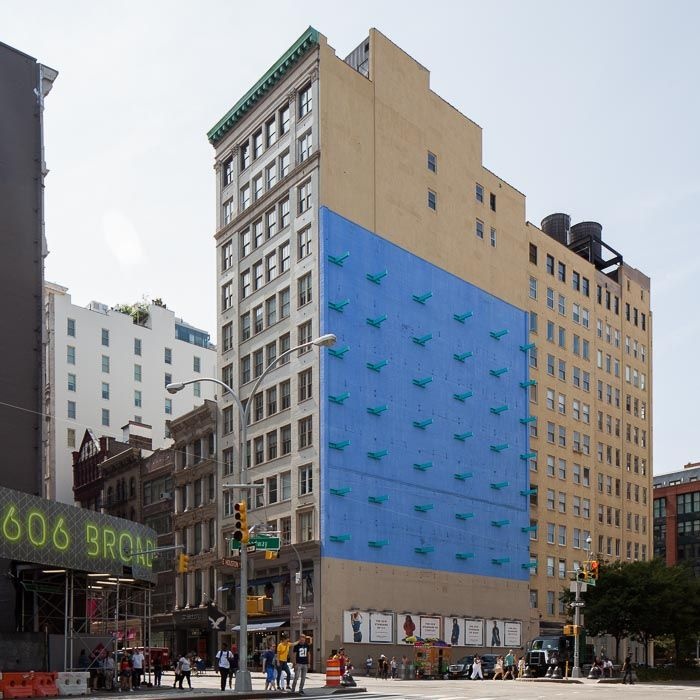
Flamingo
overview
During the post-Stonewall era, Flamingo emerged as an influential private club, operating in this SoHo building from 1974 to 1981.
Flamingo paved the way for venues that linked music and the eroticization of the white gay male body.
See the Gallery for more information on this site’s LGBTQ history.

Flamingo patrons, undated, c. 1974-1981. ©Josemar Ribeiro. Courtesy of the Michael Fesco Papers, New York University Fales Library & Special Collections.

Michael Fesco and Norma Jean at Flamingo, undated, c. 1974-1981. ©Josemar Ribeiro. Courtesy of the Michael Fesco Papers, New York University Fales Library & Special Collections.

Flyer for the Tropicana theme party, c. 1974-1981. Courtesy of the Michael Fesco Papers, New York University Fales Library & Special Collections.

Flamingo interiors, undated, c. 1974-1981. Courtesy of the Michael Fesco Papers, New York University Fales Library & Special Collections.

Flamingo DJ booth, undated, c. 1974-1981. Courtesy of the Michael Fesco Papers, New York University Fales Library & Special Collections.
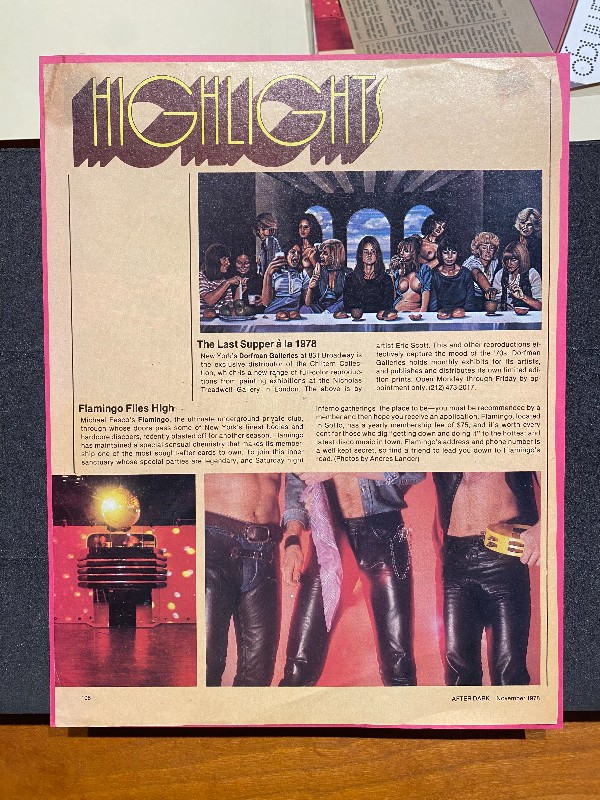
Excerpt from the magazine After Dark covering the Flamingo club, November 1978. Courtesy of the Michael Fesco Papers, New York University Fales Library & Special Collections.

Sets built for the Black Party at Flamingo (“7 cells each to house a different element in the Broadway lounge”), undated, c. 1974-1981. Courtesy of the Michael Fesco Papers, New York University Fales Library & Special Collections.

Flyer for the 1976 Christmas Party. Courtesy of the Michael Fesco Papers, New York University Fales Library & Special Collections.

Flamingo flyer, undated, c. 1974-1981. Photo by Bill Bernardo. Courtesy of the Michael Fesco Papers, New York University Fales Library & Special Collections.

“Sundays at the Studio” party flyer organized by Michael Fesco at Studio 54, 1981. Courtesy of the Michael Fesco Papers, New York University Fales Library & Special Collections.
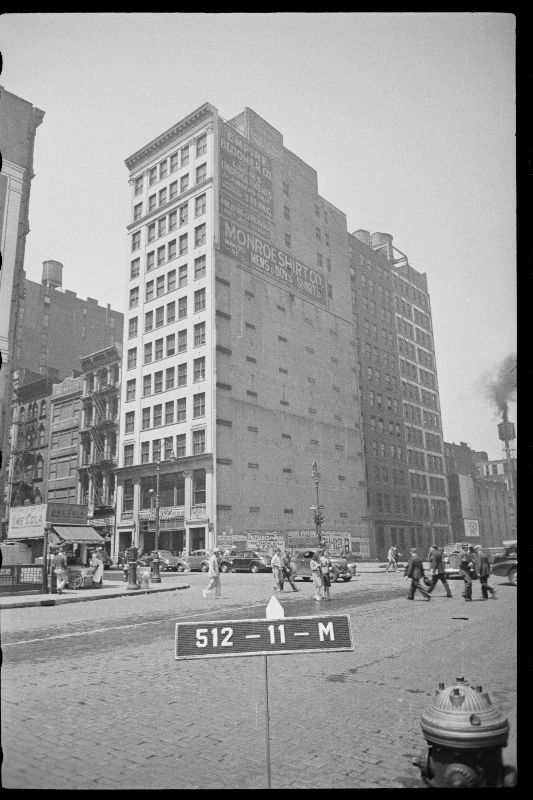
“172 Mercer Street,” c. 1939-41. Source: New York City Municipal Archives.

“599-601 Broadway (aka 172 Mercer Street),” c. 1973. The photograph shows the street entrance facing Broadway. Source: NYC Landmarks Preservation Commission.

Disco Genealogy: Tracing the Club Influences Behind the Gallery and Flamingo. Illustration by Fabio Lima/NYC LGBTQ Historic Sites Project.
History
In 1974, Flamingo and the Gallery – two unrelated clubs – opened in the same 12-story building, both drawn to the open layout of the former commercial space that made it ideal for dancing. Lines of partygoers on opposite ends of the block signaled the otherwise discreet locations. Flamingo had its street-level entrance at 599 Broadway and occupied the second floor. The Gallery, then in its second iteration, occupied the ground floor with its entrance around the block at 172 Mercer Street. These early clubs skirted cabaret licensing laws by offering only non-alcoholic drinks, and patrons often used drugs to enhance their experience. One famous example includes the acid-laced punch served at the Gallery.
Flamingo
Under the creative leadership of owner and club promoter Michael Fesco (1934-2019), Flamingo operated as a large-scale version of a private party. Inspired by the freedom he experienced at early gay discos like the Sanctuary (407 West 43rd Street), Fesco first made his mark on Fire Island’s party scene in the early 1970s at the Ice Palace in Cherry Grove before starting his search to open a premier gay club in Manhattan. The downtown location provided the perfect setting for the former Broadway performer. Flamingo could accommodate up to 2,500 people and catered to an almost exclusively white male clientele; the only people of color were often the DJs. The club was open four nights a week, from Thursday to Sunday’s Tea Dance from around 10 p.m. to 6 a.m., or starting as early as 6 p.m. for the latter.
Following in the tradition of upscale “society disco” venues like Le Jardin (110 West 43rd Street) and the Tenth Floor (151 West 25th Street), Flamingo promoted a gay identity based on masculine beauty and class. Here, the original diversity of disco gave way to homogenization, and equality was abandoned for the exclusive “A-list” format. Membership required paying a yearly fee ranging from $45 to $75, as well as being recommended by a current member. However, some cards reportedly sold for up to $500 on the black market. The “Big Bird,” as the venue was affectionately called, established a hierarchical model that would later be adopted by influential discos like Studio 54.
[T]he Flamingo became an instant gathering place for a new breed of gays who had just emerged: liberated, extremely sexual, devoted to and knowledgeable about current music, and confident of his/her role in New York City. […] Flamingo was a place where gays could always be themselves – good and bad, pretty and often not pretty at all.
This preoccupation with looking and being seen informed Flamingo’s approach to dance culture. The unobstructed space, measuring 50 feet wide and 200 feet long, could be reconfigured effortlessly. In a striking reversal, scenography took precedence over the usual importance granted to sound. Rather than allocating resources toward an innovative sound system, Flamingo featured a weekly rotation of banquettes, lighting, flower arrangements, and other decorative elements. Fesco also popularized theme parties: the leather-laden “Black Party,” the immaculate “White Party,” and the “Tattooed Cowboy Party” became much anticipated events. Beyond the exclusive door policy, the “Flamingettes” enjoyed complete freedom as they danced alongside one another. If patrons tended to reject partnered dancing, intimacy occurred in other forms, such as cruising. In October 1978, the first annual “Tetas” contest (Spanish slang for “breasts,” likely referring to the participants’ pectoral muscles) was launched, solidifying the club’s erotic atmosphere with a body-ranking competition.
Throughout Flamingo’s operation, Michael Fesco maintained close contact with his members by sending them a monthly newsletter known as the Flamingo Flash. Notable patrons included Calvin Klein, Edmund White, Douglas Crimp and Larry Kramer. DJs included Howard Merritt and Richie Rivera. At the end of the season in May, the “Flamingo Bus” waited downstairs to take members directly from the closing party to Fire Island. During the summer, when the usual crowd had left for Fire Island, the Black gay after-hours club Sesame Street, featuring DJ François Kevorkian, took over the vacant space.
By 1981, unable to compete with the grandeur of the Saint, Flamingo lost a critical part of its membership. The club closed after a final “White Party” on February 15. Fesco remained involved in the nightlife scene by promoting Sundays at Studio 54 and Sea Tea, a gay sailing tea dance on the Hudson River.
See the Gallery for more information on this site’s LGBTQ history.
Entry by Fabio Lima, project consultant (January 2026).
NOTE: Names above in bold indicate LGBT people.
Building Information
- Architect or Builder: J. Odell Whitenack
- Year Built: 1917
Sources
Bill Brewster and Frank Broughton, Last Night a Dj Saved My Life: The History of the Disc Jockey (New York: Grove Press, 2000).
Felice Picano, “Bye Bye Big Bird,” Soho News, February 18, 1981.
Landmarks Preservation Commission, SoHo-Cast Iron Historic District Designation Report (New York: Landmarks Preservation Commission, 1973).
Michael Fesco Papers (Fales Library and Special Collections, New York University, 1958-2007).
Peter Shapiro, Turn the Beat Around: The Secret History of Disco (New York: Faber and Faber, 2005).
Sheila Weller, “New Wave of Discotheques,” New York Sunday News, August 31, 1975.
Tim Lawrence, Love Saves the Day: A History of American Dance Music Culture, 1970-1979 (Durham: Duke University Press, 2004).
Will Hermes, Love Goes to Buildings on Fire: Five Years in New York That Changed Music Forever (New York: Farrar, Straus and Giroux, 2012).
Do you have more information about this site?
This project is enriched by your participation! Do you have your own images of this site? Or a story to share? Would you like to suggest a different historic site?