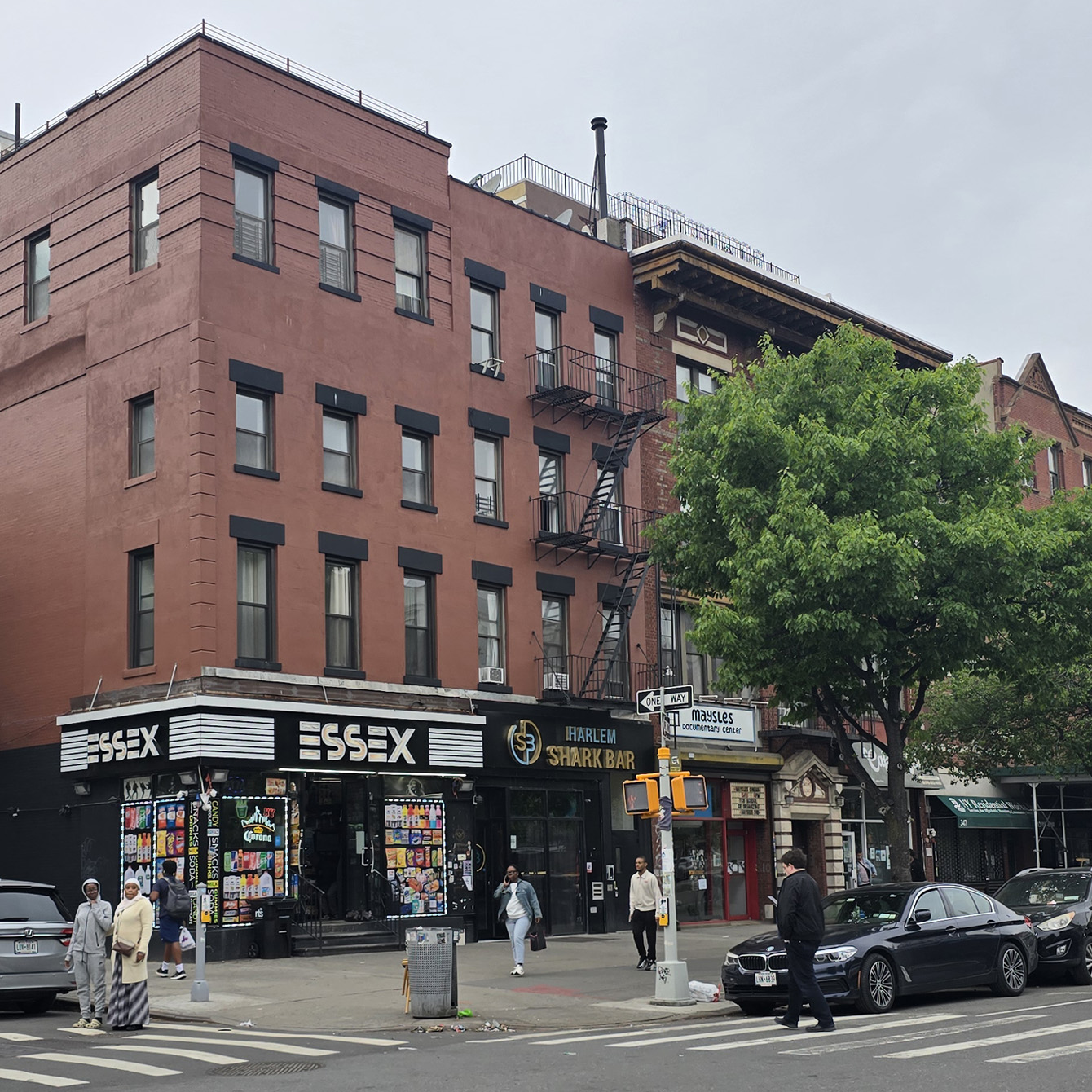
Lulu Belle Club
overview
The Lulu Belle Club was a late-1920s Harlem supper club that attracted a Black and white working-class clientele and was a hangout for “female impersonators.” Several times in 1928 it was raided by the police, who arrested men and women in one raid, but focused on men in drag in others.
The club was named after the sexually provocative and defiant title character of the controversial hit Broadway play Lulu Belle, who was adopted as an icon of the Harlem LGBTQ community.
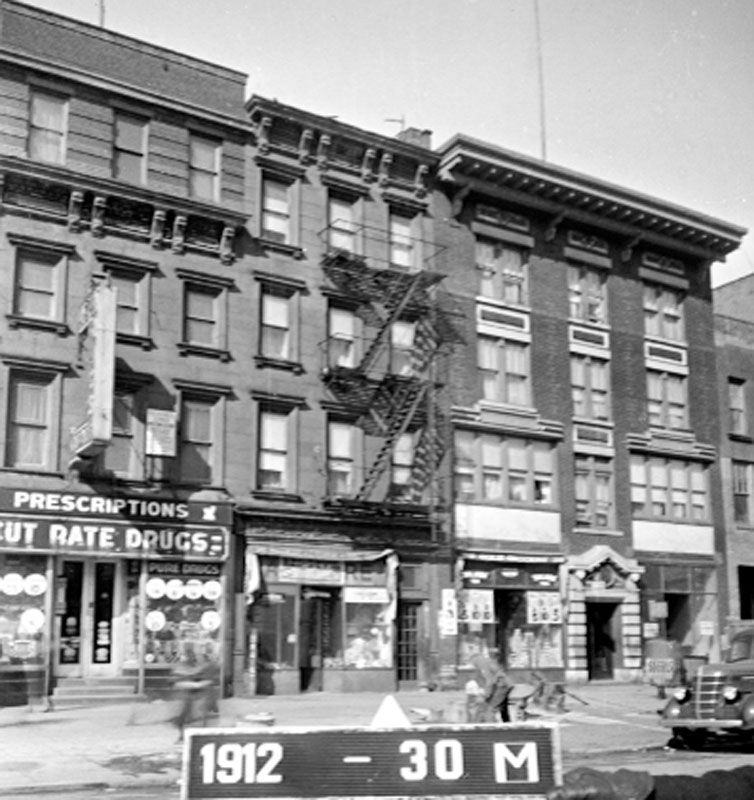
341 Lenox Avenue, c. 1940. Photo by the NYC Department of Taxes. Courtesy of the NYC Municipal Archives.
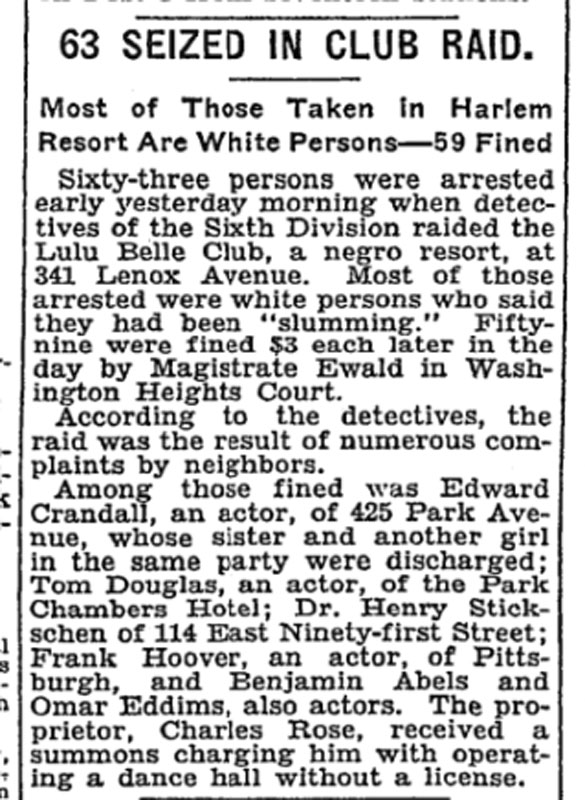
Raid article in The New York Times, January 30, 1928.
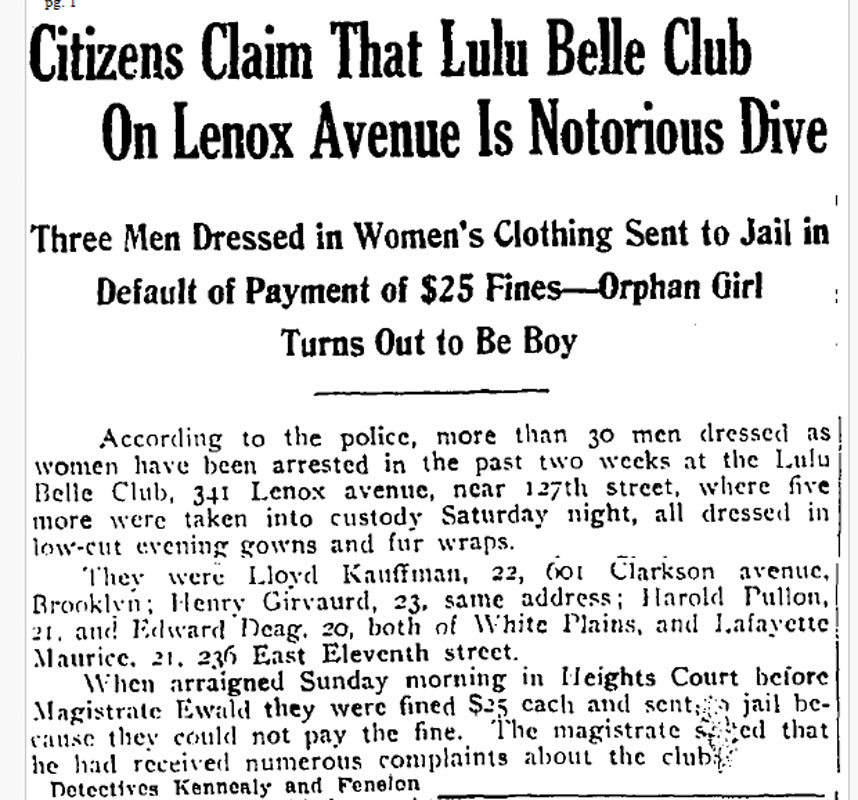
Article in the New York Amsterdam News, February 15, 1928.

Raid article in the Afro American, March 3, 1928.
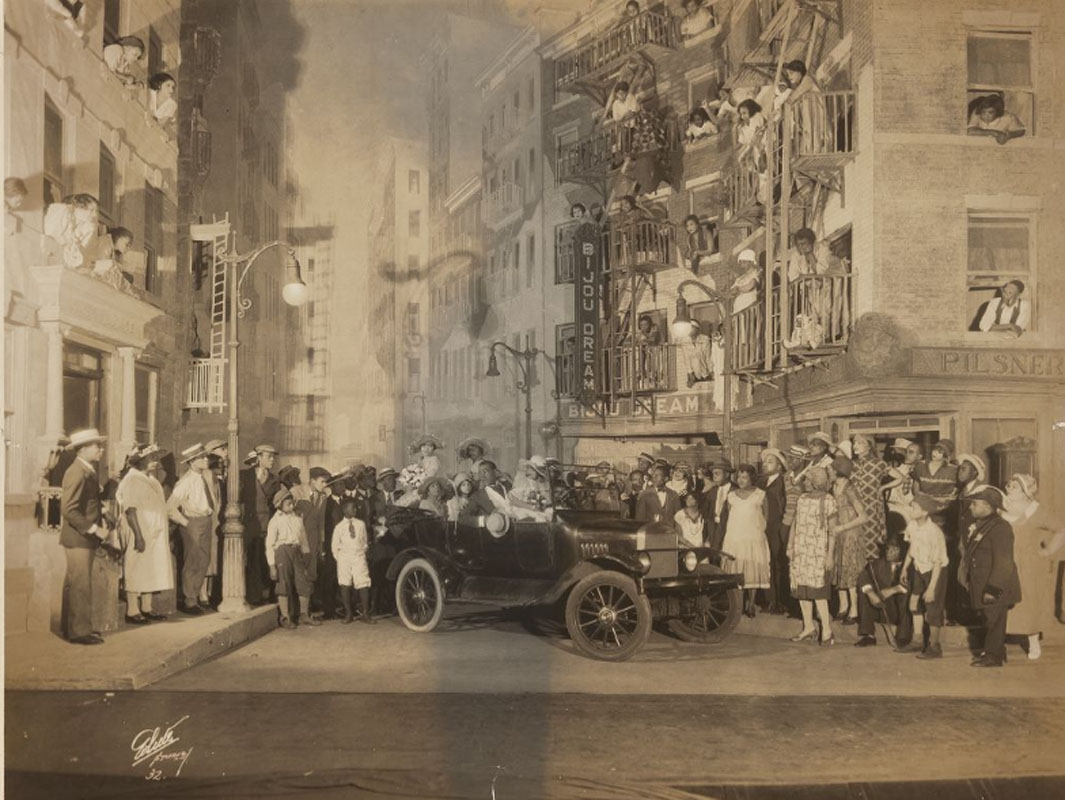
Production of the play Lulu Belle, 1926. Photo by White Studio. Courtesy of the Billy Rose Theatre Division, New York Public Library.
History
The Lulu Belle Club was a supper club at 341 Lenox Avenue in Harlem that operated for a time in the late 1920s and attracted both Black and white patrons, including gay men and lesbians. Black dancer, poet, writer, and artist Richard Bruce Nugent wrote that it had a mostly working-class clientele and was a hangout for “female impersonators” (the term used at the time). White photographer and influential cultural arbiter Carl Van Vechten noted in his diaries that he had visited the club several times.
On January 29, 1928, detectives from the Sixth Division raided the club, allegedly as the result of numerous neighbors’ complaints, and arrested 63 people. Newspaper reports called it a “negro resort” and claimed that most of those arrested were “slumming” whites, both men and women, including a number of writers, artists and actors. They were charged with disorderly conduct — 59 people were fined $3.00 by the magistrate, while four were discharged. The club’s proprietor was given a summons for operating a dance hall without a license.
On February 11, five men were arrested “in low-cut evening gowns and fur wraps,” according to a newspaper account. All of them were in their early 20s, and two were from Brooklyn and two from White Plains. Each was fined $25, but were sent to jail since they could not pay the fine. The New York Amsterdam News reported that policemen had arrested more than 30 men in drag at the club in the prior two weeks. These arrests made national news.
These men would have been charged with vagrancy under New York State’s infamous Code of Criminal Procedure Section 887, Subsection 7, which dated back to 1845 and was one of the oldest such laws in the country. This law made it illegal to appear in public with one’s “face painted, discolored or concealed, or being otherwise disguised, in a manner calculated to prevent his being identified.” While the statute had no explicit references to clothing, New York police and the courts used it often to enforce gender conformity by punishing cross-dressing and gender-non-conforming presentation.
The Lulu Belle Club was shut down for a time after these arrests, but re-opened, as noted, by Van Vechten. It is not known how long the club lasted.
The club was named after the title character of the controversial Broadway play Lulu Belle of 1926-27 that was one of the biggest Broadway hits of the 1920s and ran for 461 performances at the Belasco Theater. Claiming to depict life in Harlem and written and produced by white men, with David Belasco’s dedicated participation, it was a rare-for-the-time Broadway production with an interracial, largely Black cast. Although the 100 Black actors were given a major career opportunity to appear on Broadway, including the debut of Edna Thomas, all of the leading actors, including the one playing Lulu Belle, were white and performed in blackface. In the play, Lulu Belle was a nightclub performer who seduces a married man. Her “immoral,” sexually provocative, and shamelessly defiant character, defying middle-class conventions, caused the play to become associated with the Harlem LGBTQ community and she was adopted as an icon.
Historians consider the huge success of Lulu Belle, along with Carl Van Vechten’s also controversial, and controversially-named, bestseller Nigger Heaven (1926), as major factors in white people’s interest in Harlem and traveling to the neighborhood to experience its nightlife.
Entry by Jay Shockley, project director (February 2026).
NOTE: Names above in bold indicate LGBT people.
Building Information
- Architect or Builder: William W. Gardner; Henry A. Koelble (top story)
- Year Built: 1876; 1907 (top story)
Sources
“59 in Slum Party Fined,” Baltimore Evening Sun, January 30, 1928, 6.
“63 Seized in Club Raid,” The New York Times, January 30, 1928, 25.
“Arrest 30 Stylishly Gowned ‘Girls’ At N.Y. Nite Club,” Afro American, March 3, 1928, 5.
“Citizens Claim That Lulu Belle Club on Lenox Avenue is Notorious Dive,” New York Amsterdam News, February 15, 1928, 1.
James F. Wilson, “Chapter 3: ‘That’s the Kind of Gal I Am’: Drag Balls, ‘Sexual Perversion,’ and David Belasco’s Lulu Belle,” in Bulldaggers, Pansies, and Chocolate Babies: Performance, Race, and Sexuality in the Harlem Renaissance (Ann Arbor: University of Michigan Press, 2010).
Kate Redburn, “Before Equal Protection: The Fall of Cross-Dressing Bans and the Transgender Legal Movement, 1963–86,” Law and History Review (2002).
“Stylishly Gowned ‘Girls’ Found to Be Men,” Northwest Enterprise, March 9, 1928, 1.
Do you have more information about this site?
This project is enriched by your participation! Do you have your own images of this site? Or a story to share? Would you like to suggest a different historic site?