Mabel Hampton & Lillian Foster Residence
overview
Mabel Hampton was an Africa American performer during the Harlem Renaissance and, in the 1970s and 1980s, a key member of the Lesbian Herstory Archives.
An icon of the New York lesbian community, Hampton lived in this apartment building with her partner Lillian Foster from 1943 to 1978 (Foster’s death), and on her own part-time until 1988.

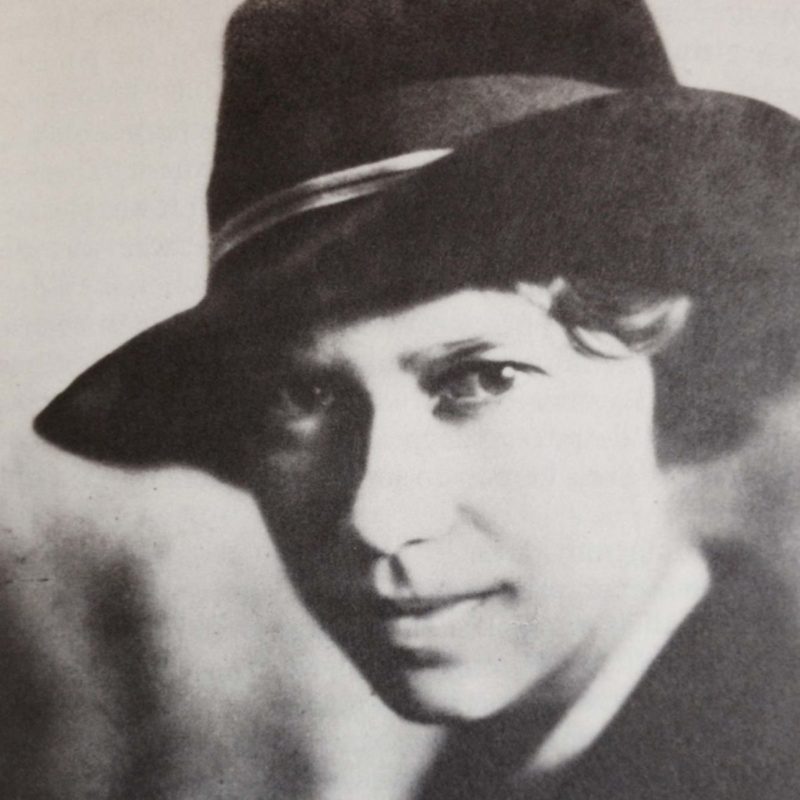
Mabel Hampton, 1922. Courtesy of the Lesbian Herstory Archives.

Mabel Hampton and Lillian Foster, c. 1940s. Source: Joan Nestle, "Don't Stop Talking 2" blog.

Mabel Hampton at her desk in her Bronx apartment, 1970s. Source: Joan Nestle, "Don't Stop Talking 2" blog.

Lillian Foster and Mabel Hampton, 1976. Source: Lesbian Herstory Archives, Herstories Audio/Visual Collections.

Mabel Hampton, with her dog Liberation, at the original location of the Lesbian Herstory Archives, 215 West 92nd Street, Apt. 13A, Manhattan, c. 1977. Source: Joan Nestle, "Don't Stop Talking 2" blog.

Arisa Reed and Mabel Hampton in Hampton's Bronx apartment, 1970s. Source: Joan Nestle, "Don't Stop Talking 2" blog.

Mabel Hampton in front of an image of Lillian Foster, c. 1980. Photo by Morgan Gwenwald. Courtesy of the Lesbian Herstory Archives.

Joan Nestle and Mabel Hampton at the NYC Gay Pride March, 1984 (event of Hampton's "All My People" speech). Source: Lesbian Herstory Archives, via Joan Nestle, "Don't Stop Talking 2" blog.
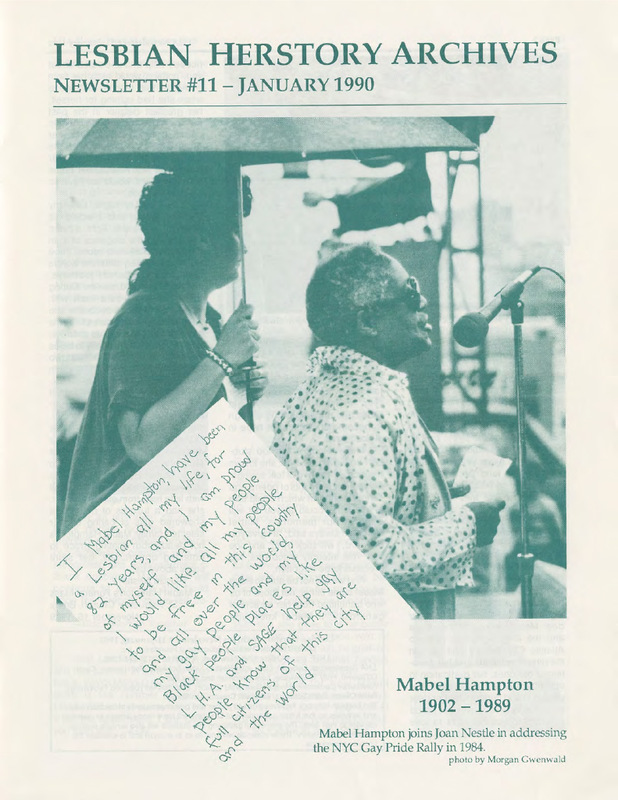
June 1990 cover of the Lesbian Herstory Archives’ newsletter honoring Mabel Hampton after her death, with photo of Hampton and Joan Nestle at the NYC Gay Pride Rally in 1984. Photo by Morgan Gwenwald. Courtesy of the Lesbian Herstory Archives.

Tax photo of 639 East 169th Street, c. 1939. Courtesy of the NYC Municipal Archives.
History
Mabel Hampton (1902–1989) and Lillian Foster (1906–1978), who referred to each other as “husband” and “wife,” lived together on the fourth floor of this tenement building in the Bronx neighborhood of Morrisania from 1945 until Foster’s death in 1978. Afterward, Hampton resided here part-time until 1988. Her oral histories and the couple’s donations of their personal items to the Lesbian Herstory Archives provide rare insight into Black lesbian and Black butch/femme life in pre-Stonewall New York.
The couple met in 1932 and first lived together in Harlem, where they held rent parties at their apartment. This type of entertainment, in which guests were charged admission to help hosts/tenants pay increasingly high rents, was a tradition at the time among the Black working-class in urban areas. Foster, born in Norfolk, Virginia, was a presser in white-owned dry-cleaning establishments until her retirement in the 1960s. Hampton, a native of Winston-Salem, North Carolina, performed as a dancer, from time to time, during the Harlem Renaissance in the 1920s. She also socialized with several of the era’s stars, such as blues singers Gladys Bentley, Alberta Hunter, and Ethel Waters. Hampton later recalled in the groundbreaking documentary Before Stonewall, “They were all in the life [LGBTQ]. I wouldn’t have been meeting them if they hadn’t!”
Hampton’s main source of income was as a domestic worker in white households from 1919 through at least the 1950s. She also worked as an attendant at Jacobi Medical Center in the Bronx from 1948 until her retirement in 1972. During that period, in 1952, she briefly worked in the childhood Bronx home of Joan Nestle, who later became an influential lesbian feminist activist, writer, educator, and, in 1974, cofounder of the Lesbian Herstory Archives. According to Nestle, Hampton “held court” on Thursday nights at the Archives (then located at Nestle’s Upper West Side apartment) and “shared in welcoming the visitors, some of whom had come just to meet her.” Her stories of lesbian life in earlier decades were popular and gave lesbians, who did not otherwise see positive representations of themselves in wider society, a chance to connect with their past. In 1976, she donated her lesbian paperback collection to the Archives.
Hampton and Foster’s East 169th Street apartment building started to deteriorate rapidly around the late 1950s, mirroring a period of urban decay, disinvestment, and rising poverty in Morrisania and the South Bronx. Based on a 1969 letter that Hampton wrote to New York City Mayor John V. Lindsay, she and her “older sister” (Foster) tried, unsuccessfully, to find a better, affordable alternative and were looking for his help. Following Foster’s death, Hampton lived on and off in Nestle’s apartment. Around this time, she became a member of Senior Action in a Gay Environment (SAGE), an advocacy and services organization for LGBTQ elders.
With the Archives, she began participating in the NYC Pride March beginning in the early 1980s and was its grand marshal in 1985. A year earlier, she addressed the crowd at the march rally:
I Mabel Hampton, have been a Lesbian all my life, for 82 years, and I am proud of myself and my people. I would like all my people to be free in this country and all over the world, my gay people and my Black people. Places like L.H.A. and SAGE help gay people know that they are full citizens of this city and the world.
When Hampton was no longer able to walk the whole route herself, younger lesbians pushed her wheelchair down Fifth Avenue. Nestle later shared in a 1992 interview with New York Newsday:
[Hampton] represents what’s at the heart of the archives. In most traditional cultural institutions, her life would pass from our view, but we believe any woman who has the courage to touch another woman is a famous lesbian. Mabel Hampton’s life suggests another paradigm for doing history—not around coming out or bar culture, but around daily survival as a worker and an African American woman who never apologized for her sexual life.
Hampton was featured on the June 1990 cover of the Lesbian Herstory Archives’ newsletter after her death. It included a tribute from Nestle and a selection of the many letters and notes sent by members of the lesbian community in Hampton’s memory.
Entry by Amanda Davis, project manager (March 2017; last revised November 2026).
NOTE: Names above in bold indicate LGBT people.
Building Information
- Architect or Builder: James F. Meehan
- Year Built: 1901
Sources
Joan Nestle, “Excerpts from the Oral History of Mabel Hampton,” Signs, Vol. 18, No. 4, Summer 1993, pp. 925-935. [source of pull quote]
Joan Nestle, “Hampton, Mabel,” ed. Bonnie Zimmerman, Encyclopedia of Lesbian Histories and Cultures (New York: Routledge, 2000).
Joan Nestle, “’I Lift My Eyes to the Hill’: The Life of Mabel Hampton,” Don’t Stop Talking blog series, October 27-29, 2011, bit.ly/2d2bhLL.
Do you have more information about this site?
This project is enriched by your participation! Do you have your own images of this site? Or a story to share? Would you like to suggest a different historic site?